Monday, June 17, 2019

Another Visit to the Alex Toth Casting Agency

Need a different look for an NPC or a weird monster of some sort? Check out the model sheets and concept art created for Hanna-Barbera by the late, great Alex Toth:

Cyclops:


Dragon, Four-eyed:


The rulers of the cat people:


A wizard and his pets:


A wizard with a nose piercing and fairy lackeys:


Thursday, June 13, 2019

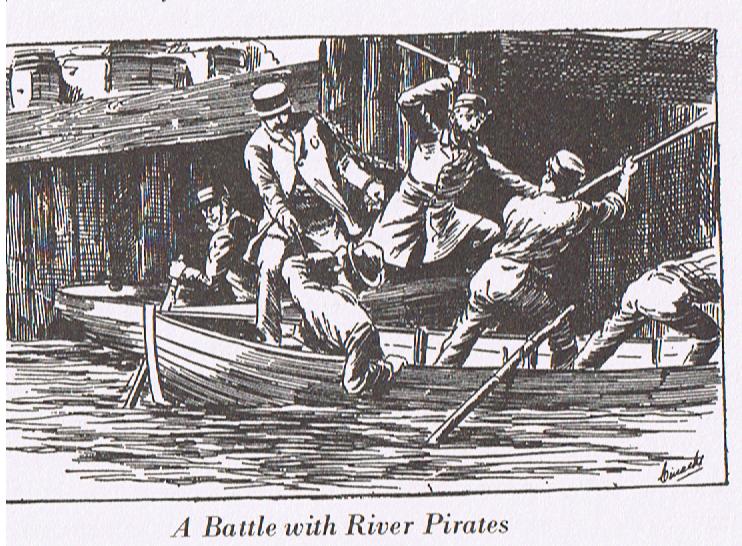
Weird Revisited: Waterfront Rogues

This post originally appeared in 2014. I think I will have to add a few more of these sorts of operators to the environs of Rivertown in the Land of Azurth.

Ocean-going pirates and landlubber thieves are common rpg archetypes, but there's another group, less dear to the pop culture imagination, that sort of bridges the gap between the two. The river pirate lurks in that gap, connecting the urban, wilderness, and sea-going adventures into one larcenous tapestry.

This sort of thing has gone on as long as there have been boats and things to steal, of course, but there are some great examples of this from American history. The Cave-In-Rock game operated out of this place on the Ohio River:


The 1790s were the high point of the piracy there. Samuel Mason and his gang robbed flatboats carrying farm goods to markets in New Orleans.

Still, the Cave-In-Rock gang aren't near as colorful as their urban counterparts. Consider Sadie Farrell (also known as "Sadie the Goat" for her modus operandi of headbutting male victims so her accomplice could mug them), a leader of the Charlton Street Gang. In 1869, the gang stole a sloop on from the waterfront on Manhattan's West Side. They embarked on a piratical spree, reading up and down the Hudson and Harlem Rivers, even going as far as Albany, supposedly. They robbed small merchant vessels, and raided farm houses and Hudson Valley mansions, occasionally kidnapping people for ransom. Sadie was said to have made male captives "walk the plank" on occasion. Eventually, the villagers organized and began to fight back. The gang was forced to abandon the sloop and return to street crime. One assumes it was fun while it lasted.


The Swamp Angels had an even more innovative approach. Based in a Cherry Street tenement named Gotham Court (also called "Sweeny's Shambles"), the Swamp Angels had a secret entrance to the sewers. There they made their lair and launched their nocturnal raids on the East River docks. Here's what the chief of police said about them in 1850:

"[they] pursue their nefarious operations with the most systematic perseverance, and manifest a shrewdness and adroitness which can only be attained by long practice. Nothing comes amiss to them. In their  boats, under cover of night, they prowl around the wharves and vessels in a stream, and dexterously snatch up every piece of loose property left for a moment unguarded."

The police tried waterfront snipers then sewer raids to fight the bandits on their own turf. Only regular sewer patrols drove the gang from its subterranean lair. Even those didn't end their piratical ways.

More interesting and game-inspiring tales of riverside criminality can be found at your local library. Or the internet.

Wednesday, June 12, 2019

Wednesday Comics: A Return to Storm

It's about time I got back to my exploration of the long-running euro-comic Storm. This is a repeat of the beginning of Vandaahl the Destroyer to freshen your memory. Earlier installments can be found here.


Storm: Vandaahl the Destroyer (1987) (part 1)
(Dutch: Vandaahl de Verderver)
Art by Don Lawrence; script by Martin Lodewijk

In a small, strange universe, somewhere in the multiverse, a war which has lasted for millions of years comes to an end. Vandaahl the Destroyer, Lord of Chaos, Agent of Death, is brought before his triumphant enemies. He gloats that he won the moment they chose to take up arms against him, and he relishes the irony that they will now kill him in the name of peace.

But his enemies don't plan to kill him. Instead, he will be locked in the Armor of Eternity. He will be held in stasis until the end of time. They also plan to throw the armor into a black hole. They are unsure of what will happen. The All-Creator will decide his fate.


Apparently, the All-Creator isn't done with Vandaahl. Drawn into the black hole, he isn't destroyed, but instead shunted through a white hole into another universe...


He comes down like a meteorite into the water world where Storm, Ember, and Nomad have been living with a community of fishermen. Nearly drowned in the resulting wave, our heroes decide to dive down and investigate when they see a glow beneath the water. Storm and one of the fishermen don special jellyfish and diving helmets and go down.


The next day, they come back to haul up the armored figure. Storm weirdly has a hard time touching it, like his hand and the figure are two magnets, repelling each other. They take the mysterious figures back to the fisherfolks' nest to take counsel with the elders.

While the adults are talking, children are playing around the figure. They inadvertently activate some controls...


And Vandaahl lives!

TO BE CONTINUED

Monday, June 10, 2019

Superheroic Hooks

While not exhaustive, this is a list of recurring story hooks common in superhero comics from the Silver Age on, though focused on the Silver and Bronze Ages. They are geared toward teams of heroes and those of moderate power level, as "street level" heroes can get into adventures just by going on patrol and spotting mundane crime. Still, they are probably useful at any level.

Assault: the heroes are attacked, either individually or as a group.
Challenge: An NPC challenges a hero to some sort of contest, be it combat, a chess match, etc.
Clandestine Attack: Heroes are plagued by some something not immediately recognizable as an attack (poor public relations, bad luck, problems with powers), but actually is.
Clash of Cultures: A misunderstanding or disagreement leads to conflict with heroes from another nation/world.
Crasher: An NPC of uncertain motivation appears in or invades the heroes' base/home.


Disaster: Sort of a natural or unnatural disaster occurs. This may also be a Clandestine Attack.
Doppelganger: A duplicate of one or more heroes or supporting cast members appears, either amnesic or claiming to be the genuine article.
Framed!: A hero or supporting cast member appears to be guilty of a major crime.
Gift: Heroes receive a mysterious item, base, or job offer.
Harbinger/Messenger: A stranger arrives either announcing the arrival of a greater threat, or to seek the heroes' help in stopping this threat.
Invasion: An attack by a force from another world, country, or time.

Invitation: Heroes are invited to a research facility, upscale party, movie studio, foreign country or the like.
Kidnapped: One or more of the heroes is kidnapped.
Manipulation: The heroes are being maneuvered into a course of action advantageous for the villain.
Masquerade: Someone is pretending to be one or more of the heroes.
New Hero: A new hero of uncertain motives appears either as a rival or aid to the heroes.
Quest: Similar to the challenge, but the heroes must overcome some challenge to acquire an item or achieve some other goal.


Return: A long-missing hero reappears.
Siege: An Assault of some sort traps the heroes in their base or home.
Shutdown: A political/public relations issue leads to authorities threatening action against the heroes.
Villain Multiplied: Previously solo villains form a team.
Upgrade: A villain or hero has a mysterious increase in power.

Friday, June 7, 2019

Weird Revisited: Mo' Mummies

The original version of this post appeared in 2013. The tomb is reopened...

MUMMY, BOG
These mummies were naturally created but are instead products of being buried in peat bogs. They aren't wrapped in bandages, their skin in tanned black, and they are more flexible than their fellows due to calcium phosphate in the bones being dissolved by bog acid. They only do 1d8 damage and have one less hit dice, but they can vomit acid for 1d4 damage.


MUMMY, GIANT
Humans weren't the only ones to be mummified, or to rise as fearsome undead monsters. Giant mummies have hit dice one better than what ever giant humanoid their size resembles or one better than standard mummy hit dice, whichever is better. They have all the standard mummy abilities, except (in some cases) mummy rot. (Check out Gomdulla above statted here.)

MUMMY, LOVELORN
These mummies got caught in a forbidden romance and were mummified as punishment. When first revived, they look like regular mummies and have all the pertinent abilities, but within 1d4 days, they shed their wraps (and most of their powers) in favor of a brooding, exotic charm. They typically become convinced someone is the reincarnation of a long dead love, and will go about trying to woo the lost lover, killing those that get in the way. They are able to Charm (as per spell).


MUMMY, WELL-PRESERVED
These mummies have several unusual traits--most obvious of which is they are as attractive as the day they died, instead of being desiccated corpses. They don't have the mummy rot or the fearful reaction, but to do possess a charm ability (as per the spell). Typically, some sort of ritual is needed to fully resurrect one (involving some sort of item important to them in life and several blood sacrifices) of these mummies, but until then they are able to exert their will by control of others.

Wednesday, June 5, 2019

Wednesday Comics: Social Histories of Comics

A bit of a depature for this Wednesday, a couple of books about comics and comics history. Despite the similarity in stated goals and the basic facts they cover, the works have different perspectives that make both valuable.

Comic Book Nation: The Transformation of Youth Culture in America (2002) by Bradford W. Wright is more of a social history. He shows how the messages conveyed by comics shift from the Depression to the Cold War. Like traditional comics histories, he places some importance on EC, but particularly to note how their comics countered "the prevailing mores of mainstream America." Western comics are left out of his analysis--perhaps he feels they are better analysed in general discussions of the Western genre? He also omits underground comics from his discussion.

Of Comics and Men: A Cultural History of American Comic Books (2009) is by French academic Jean-Paul Gabilliet. Despite the title, Gabilliet deals less with prevailing cultural attitudes and their relationship to comics, but is more rigorous and analytical regarding the events of comics history, often citing sales figures and the like. Retail and distribution play a bigger role here than in popular comics histories; for instace, Gabilliet makes a persuasive argument that the Comics Panic of the 50s and the emergence of the Comics Code hurt comics, but really only the smaller publishers and even there perhaps only because sales were already on a downward trajectory from an all-time high. He also describes how Watchmen and the Dark Knight Returns represented a renewal for DC and were important the trend that saved the industry from the decline throughout the seventies.

Monday, June 3, 2019

Godbound: The Power of Grayskull


This was not my original "other idea" for Godbound by Kevin Crawford, I mentioned in my post a Greek myth-based Godbound game, but it occurred to me since then, and I thought it was good enough to share. Masters of the Universe (okay, He-Man and the Masters of the Universe, for those who came to it from the cartoon) is essentially a world of fantasy superheroes, exactly the sort of thing Godbound does, though maybe not so stereotypically.

Eternia is a shard of what was an advanced civilization, spanning multiple planets, perhaps multiple planes (all presided over maybe by semi-divine beings known as Trollans). Either its science or its magic was so advanced that there was no difference between the two. The Great War brought that civilization to an end and shattered the cosmos. The once great master control center/central terminus of the Ancient Ones collapses into a ruin. Its folded, multi-dimensional structure is partially perceivable millennia later as a gray, skull-visaged fortress of stone. Castle Grayskull to the uncomprehending civilizations that would follow.

The power of Grayskull is palpable and known. From all over Eternia, from shards of nightmare worlds, beings come seeking its power for themselves. These seekers are more than human. They are those imbued with strange powers by exposure to ancient energies, or wield ancient weapons. Grayskull chooses its champions, though, to defend its secrets.


You get the idea. One could, of course, jettison all the silly MotU names--or keep them if they seem integral. The sort of nonsensical terrain of Eternia makes more sense when it's just the condensed highlights of something once much more coherent and larger, kept functional by magitech. Likewise, the sort of random powers/prosthetics of the characters can be explained as idiosyncratic manifestations of ancient magic tools/artifacts.

Sunday, June 2, 2019

Weird Revisited: Subterranean High Strangeness

This post first appeared in 2013, but I felt like it was worth a rerun. Some interesting storys to inspire dungeoneering, perhaps in a modern conspiracy/horror game.

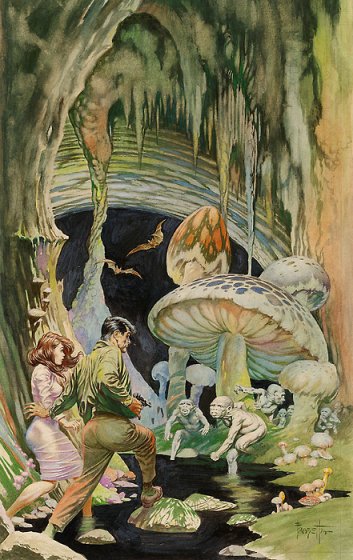
Frank Frazetta
The old cliche says "truth is stranger than fiction." I don't know if any of the tales here are true, but hey, they're presented as such--and they're certainly strange. Strange in a way that would be great fodder for modern (or modernish) adventures, particularly of the dungeoncrawling sort:

Subterranean Lumberjacks
On December 26, 1945, there was an explosion in the Belva Mine in Fourmile, KY. What was apparently reported much later (1980-81) was that survivors recounted takes of a "door" opening up in a wall of rock and a man dressed like a "lumberjack" or "telephone lineman" emerging to reassure them they would be rescued. He then disappeared the way be came.

Trapped miners in Shipton, Pennsylvania, experienced similar strangeness. Again survivors reported meeting strange men (similarly clad to the Belva lumberjacks, according to some accounts) who told them they would be rescued and gave them a bluish light and showed them some halographic visuals. The miners seem to have been unclear if their benefactors were fully corporeal. I bet.

Mine Monsters
It could be a lot worse. Just read this pretty likely untrue account that appears on a lot of internet paranormal sites:
PENNSYLVANIA, DIXONVILLE - Mine inspector Glenn E. Berger reported in 1944 to his superiors that the Dixonville mine disaster which "killed" 15 men was not the result of a cave-in, but rather an attack by underground creatures capable of manipulating the earth [partial cave-ins], whose domain the miners had apparently penetrated. Most of the dead miners were not injured by falling rocks but showed signs of large claw marks, others were missing, and one survivor spoke of seeing a vicious humanoid creature that was 'not of this world' within an ancient passage that the miners had broke into. The creature somehow created a "cave-in", blocking himself and another inspector [who closed his eyes when he felt the creatures 'hot breath' on his neck] from the main passage until another rescue party began to dig through the collapse, scaring the "creature" away. 
Shaverian Mysteries
The monsters don't confine themselves to miners, apparently. The 1967 issue of the Hollow Earth Bulletin prints portion the so-called "The Messerschmidt Manuscript" that proports to give the account of a French woman, who describes her horrifying kidnapping at 19 by deros (or something similar) from an elevator in a building basement in 1943. She and other women endured months of captivity in the hands of monsters than sound a lot like George Pal's morlocks in physical description until they were rescued by pale men in gray, metallic uniforms who slaughtered the beastmen and gave the former captives clothing and medical attention.

44 Cities
It's not all monsters down there, though. An article in the Summer 1978 issue of Pursuit Magazine puts forward a claim by a Dr. Ron Anjard that he knew personally of 44 underground cities in North America. He learned this from anonymous Native American sources. Maybe these relate to the lost cities of the Grand Canyon? Or some of those giant containing tombs?

Thursday, May 30, 2019

The Charmed Life of an Adventurer


"Prophecies and charms marked his face, talismans against attacks from animals, demons, and men."
- Brian Catling, The Vorrh
Some editions of D&D have felt suggested magic items were required equipment at certain levels. Even before that, the fact that you could sell magic items suggested the existence of places they might be bought: Ye Olde Magic Shoppe. Neither of these facts have ever sat well with some people, who view these as part of a mundanifying, possibly even industrializing of magic. In general, I would count myself among them, though it depends on the setting, really.

There is a way to have common magic items without sucking the mysticism and mystery out of them and raising the specter of industrialization. That would be to replace many magic items with with charms or fetishes. Charms (and blessings) are mentioned in the 5e DMG , but they are envisioned as short-term or single issue enchantments on an individual. I think they could be applied to items, though they still might be single or short-term use to differentiate them from standard magic items.

There might be other differences:

  • They would appear more like art objects than practical tools, though they might also be laid into practical tools (or people) with markings/runes.
  • They could be acquired at shops, but they would generally bespoke, not bought off a shelf (though some might be).
  • They would be pretty common, almost ubiquitous among adventurers, but they would be more specialized. Instead of a Ring of Protection, their might be a talisman of protection against weapons, one against magical attacks, one against the claws and teeth of beasts. (This approach would require more record-keeping, but might or might not be worth it.)


A lot of the adventurer's acquired wealth would go into buying new or longer lasting charms. Healing potions could stay potions, but they could be replaced with poultices or talismans instead. Maybe their would be a mixture of both, and could be purchased. "True" (permanent) magic items would be rarer, and perhaps only found among the ruins of the past. They would almost never be sold.

Wednesday, May 29, 2019

Wednesday Comics: Things I Read Last Week

These are the comics I've read over the past week. Only one of them is new.

Martian Manhunter (2018) #5
John Jones discovers he's not the only Martian that survives his planet's death, and he needs John Jones partner, Diane, more than ever to bring him in. The parallel story of the last days of Mars draws incrementally closer to its tragic end. This continues to be one of the few current comics I'm interested. but the decompression is starting to wear on me.

Kill 6 Billion Demons Book 3
I confess the first two installments of Kill 6 Billion Demons were interesting to me because of the setting, and because I thought it was leading to somewhere cool. This volume, though, I enjoyed for what it was doing at the moment. Here we get an epic heist story or classic D&D setup in the city of Throne itself.

Black Hood (1991)
Black Hood was the last of the ongoing series as part of DC's Impact Comics line, a resurrection of Archie's MLJ heroes. Black Hood has the best high concept and the best first issue of the Impact titles: It ends with its Punisher-esque, journal-narrating, vigilante hero getting killed, and a teen age kid taking up his mask that is more than just a simple piece of cloth. The premise unfolds less grittily than one might image given that '91 was when comics were at peak anti-hero, but then the Impact line was aimed a bit at younger readers, which in that era didn't mean anime-inspired stylization in the art and more simplistic stories, but instead younger protagonists and less violence. Sort of. The whole series is available on Kindle/Comixology.

Sunday, May 26, 2019

The Genre of D&D Art?

Jason "Dungeon Dozen" Sholtis and I were talking the other day, after we both watched Eye of the Beholder, the new documentary on D&D artists (which you should see too). Jason was skeptical of the idea (mentioned in the documentary) that "D&D art" was a genre, instead viewing it as part of the wider field of fantasy illustration. I put forward an argument, that he found at least somewhat convincing, that D&D (or rpg) art, might at least constitute a subgenre of fantasy art, and that it could be identified by its tendency to emphasis certain traits across several editions. Here are the traits I came up with:

Prosaic or Humorous Scenes
While fantasy illustration is no stranger to humor or protagonists that are less than competent, but not large than life, these sorts characters are depicted in a higher proportion of D&D art.


More Detail on Monsters
Monsters in much traditional (pre-D&D) fantasy illustration are best described as "phantasmagoric" or fanciful, charitably--and perhaps even outright goofy. D&D monsters are not always anatomically or realistically considered but they are generally detailed and usually dynamic.

Placing the Viewer with the Protagonists
The eye of the viewer is often positioned as if they might be a companion of the pictured protagonists or at least a close observer, rather than viewing the action at a remove. The primary focus then is often placed on the antagonist (or monster) rather than the heroes.


Emphasis on Small Groups Rather than Individuals or Clashing Armies
This one is obvious due to the "party" structure of rpgs, and it is perhaps the one most frequently supported by the art. The party is often displaying teamwork.

Anyway, I think those sort of make the point. I do think there are some others regarding costuming and composition of scenes, but these are the ones I feel most certain about. Of course, there is a lot D&D art that don't show these characteristics and there is some non-rpg fantasy illustration that does. These are really about tendencies, not absolutes.

Friday, May 24, 2019

Weird Revisited: Ursoid Mutant Dunes

The original version of this was posted in 2015, shortly after I had seen Mad Max: Fury Road.

I've got just the thing for a Mutant Future or Gamma World mini-sandbox: do a bit of reskinning on Chris Kutalik's Slumbering Ursine Dunes (if you don't have copy--well, it's available now.)  Here's some thoughts on changing the basic setup.

Out in the desert, there's an ancient rune and a crashed alien spacecraft, slowly burning holes in reality itself.

The Background as Only the GM Knows It
Milt Grisley was an underground cartoonist who got his chance to sell out in the eighties. His Sleepy Beartm character went from counter-culture anti-hero to toyetic, afernoon cartoon pitch-man--and made Grisley rich in the process. Theme parks followed--the one outside of Las Vegas was the biggest, Once Grisley was well into Howard Hughes level eccentricity, he even had a futuristic, planned community built nearby. It was going to be a utopia in the desert run by a super-conputer and thoroughly Sleepy Bear-branded. Then the bombs dropped.

The super-computer has grown more self-aware over the centuries--and also crazier. It thinks it's the real Sleep Bear, now. Its public face is one of the old animatronic, amusement park bears. Somewhere along the way, a tribe of mutated ursoids found it (perhaps following the old signs emblazoned with Sleepy Beartm) and now worship it like a god, following the computer's every command no matter how ridiculous.


They lived peaceable and kept to themselves. They even allowed some humans to settle nearby. Everything was fine until the crash. A saucer full of Greys, sliding across dimensions, went down in the desert near the installation. Maybe it had something to do with a top secret military installation the government never officially acknowledged that was hidden near Bear Town, or maybe it was just a freak coincidence. Whatever the cause, crash it did, and its reality-shifting engines went critical, dumping their cosmomorphic fuel all over the landscape, turning everything weird...


So, hopefully the recastings are clear: Medved is the super-computer whose avatar is an animatronic cartoon bear. The Eld are Greys and their golden barge is a big saucer (don't worry about the different deckplans. It's weird on the inside.) The Weird is created by spaceship fuel. Ondrej is probably a mutant shark and cartoonish pirate, holed up in the pirate island in the middle of the brackish and radioactive artificial lake in the amusement park.

See, not so hard? I'll let you take it from there. Make your own adventure in the Mutants Dunes.

Thursday, May 23, 2019

The Secrets of Harveylands


This map of "various Harveylands" comes to us from Richie Rich #230 (1987). Before its publications, the proximity of many Harvey characters was apparent, but the fact that their entire kids comic "universe" existed in one locality was a bit of surprise. Looking at the map, I think we can discern other truths about the "Harvey Universe."

The mountains separating it from the outside world reveals it to be a hidden land in the old tradition of Oz or Opar. It is primarily inhabited by magical or fairytale creatures (some in semi-isolated subregions), with one isolated island being the home of talking animals. Based on the comics, these animals enjoy a higher level of technology and infrastructure than the surrounding "enchanted forest" dwellers (though so stories suggest at least the Devils have access to TV and radio.) There are also the two anomalous comics related industries.

Richville's wealth and isolation are a bit of a puzzle. I suspect it is something like the isolated Amazon cities of the rubber boom. The only question is what provided the fortune for the Richs and their city? Whatever it is, it likely has something to do with the magical nature of the surrounding countryside.

Spooktown seems to be the next largest city, and it is walled. Possibly it isn't open to non-ghosts? Maybe witches, since they seem to live in close proximity. Spooktown is big enough that it has suburbs, apparently, where Casper resides.

I always took Tiny Town to be a settlement of normal humans in the Stumbo stories--tiny only in comparison. I wonder now if they are actually smaller, and so Stumbo's size in the stories was exaggerated by the comparison.

Wednesday, May 22, 2019

Wednesday Comics: Charlton Action Heroes

Since I've covered the MLJ/Archie characters recently, and the Tower Comics T.H.U.N.D.E.R. Agents back in 2017, it's time the Charlton Comics "Action Heroes" got there due. Charlton had published superheroes in the Golden Age, but what they are remembered for (well, besides what DC has done with their characters since) is their Silver Age publications.

Like Archie Comics' hero universe, Charlton's had an early, false start. In the wake of DC's Silver Age success in the late 50s, Captain Atom by Joe Gill and Steve Ditko debuted in the science fiction anthology series, Space Adventures, starting in 1960. Captain Atom last appeared there in 1961 and by the end of that year, his artist was doing seminal work for Marvel.

In 1965, with Marvel and DC enjoying great success with superheroes, Charlton revived Captain Atom with reprints. The Golden Age Dan Garrett Blue Beetle had been reworked and re-introduced in 1964, but that character and Charlton superheroics really took off in 1966 when Dikto returned. His renewed work with Captain Atom and his introduction of a new Blue Beetle led Charlton editor Dick Giordano to debut the "Action Heroes" line. Along with these two Ditko characters (and later the Question), Giordano included Peter Morisi's Peter Cannon...Thunderbolt, Frank McLaughlin's Judomaster, and Pat Boyette's Peacemaker.

Unfortunately, the Action Heroes were not a resounding success. By the end of 1967, all the series were cancelled. After the demise of Charlton in the 80s, DC would acquire the characters. It's thanks to DC that we have any of the Action Heroes material collected at all. Maybe we'll eventually get an omnibus due the Watchmen connection?

Peter Morisi's estate owns Peter Cannon. Dynamite Comics currently has the license for him and has published two series since 2012, the latest is currently ongoing.