Wednesday, December 11, 2019

Wednesday Comics: DC Special Series #21

We're going to be reviewing this issue on the upcoming Bronze Age Book Club podcast, so it seemed like a good time to revisit it here...


Super-Star Holiday Special
DC Special Series #21 (Spring 1980). Cover by Jose Luis-Garcia Lopez

Synopsis: Len Wein tells it like this:


Iffy history aside, it's a good enough intro for 4 seasonal tales in the DC universe.  First up, Jonah Hex:

"The Fawn and the Star" Written by Michael Fleisher, art by Dick Ayers & Romeo Tanghal

It's Christmas eve, and Jonah Hex is after the Tull brothers across the snowy wilderness. He comes across a little girl and her father fighting over whether to kill a fawn with a hurt leg. Uncharacteristically, Hex sides with the girl and even bandages the animal's wound. To mollify the father, Hex agrees to get him something else for the family's Christmas meal. Maybe Hex's show of softness is due to a similar episode in his childhood. He saves a raccoon from a trap and nursed it back to health in the family barn. When his father found it, it wound up on the families dinner table.

Hex follows the bright star in the south and comes to a cave. The Tull boys are hiding there. In a firefight, Hex blows them up with dynamite, but somehow manages not to mangle them too badly to collect his bounty or destroy their stuff--which includes a bunch of provisions for the trail he takes back to the relatively greatful family. We can only hope the Tull brothers learned the true meaning of Christmas before their deaths.

Next up, it's Christmas Eve in Gotham...

Written by Denny O'Neil, Art by Frank Miller & Steve Mitchell

Crime never takes the night off--someone even stole a star off the department store nativity scene-- but luckily neither does the Batman. He moves through the sleet-coated night to a party thrown by Matty Lasko. Lasko has a boat waiting in Gotham harbor and that's enough to raise Batman's suspicion.  After Batman roughs up some goons, Lasko tells him it was a favor for an old cell-mate: Boomer Katz.

At a soup kitchen in Crime Alley, one old timer asks another about Boomer Katz and finds out Katz has got a job as a Santa at Lee's department store. The old timer leaves an envelope surprisingly full of money, and sheds his disguise on the roof, revealing himself to be the Batman. He's certain the only reason Katz would have gotten a job at a department store is to case the joint, and Lasko must have arranged his escape. It's a shame , too; Even Batman believed Katz had finally gone straight.

At the department store, Lee is having second thoughts. When his boss praises his skill as a Santa, it brings a tear to his eye. Out by the nativity scene, he tells Fats (a bald guy that holds a cigarette holder like a German in a movie) he can't go through with it. Fats isn't cheered by this turn, and he and his goons pull guns then force Katz to get them in to the store's service entrance. They're after the store's daily receipts. When they've got them, they plan to kill Katz, but he throws a box of ornaments at the thug and runs away. He's shot in the shoulder but manages to escape.

Batman hears the shots. He bursts through the window and saves the store manager from Fats, taking him down with a small Christmas tree. The manager tells Batman how the thugs forced Katz to help them and are now trying to kill him.

Inbeknowst to Batman, the thug has his gun to Katz's head and his holding him somewhere near the nativity scene. Batman has been unable to find Katz, but ironically, he's nearby talking to a cop. Batman looks up and notices the star is back on the nativity scene and its light is shining on--Katz and his would-be killer!

Batman saves Katz and takes out the thug. And that star?


Batman is pretty unconcerned, but I guess in a world with Superman and Green Lantern and what have you, stuff happens.

The holiday spirit moves us again, next week.

Monday, December 9, 2019

In Sly Took's Vault


Our Land of Azurth 5e campaign continued last night with the party revising, then attempting there plan to break into the criminal vault of Sly Took (brother to Mapache Took of the Racoon Thieves Guild) to steal back the ill-gotten gold of former Mayor Gladhand. They decide on a classic "Trojan Horse" plan using the Armoire of Holding they acquired long ago as the horse.

Waylon and Kully play at delivering their presumably magic item stuffed armoire for safekeeping at the vault. The two meet with the vault manager Wotko (a red panda person, oddly) and everything goes smoothly at first. After depositing the armoire in their assigned vault, they get the moment they've been waiting for and attack Wotko and his subordinate to get their keycharms.

What they hadn't prepared for was the invisible stalker that guarded the vault. As soon as they attack Wotko, it attacks them. After a couple of rounds, Dagmar recalls she can abjure elemental spirits, and she turns it.


The party quickly grabs the keys. They take Gladhand's gold from another strongbox (all 600 lbs. of it!) and close up the armoire. Bell magically disguises herself as Wotko, just as a group of guards approach them...

Sunday, December 8, 2019

Pai Mei and Ringlerun

Reading book one of Legend of the Condor Heroes by Jin Yong, I've been reminded that D&D shares perhaps unexpected similarities with wuxia, the Chinese genre of martial arts adventures:

Advancement is important. adventurers go on adventures, martial artists train, but the desired result is the same.
High level characters can perform superhuman feats that are not necessarily viewed as superhuman within the fiction. D&D characters get extra hit points to shrug off attacks or various other special abilities (particularly in editions after 2nd). Wulin heroes get to fly around and do things with focused internal energies.
The protagonists are a class apart from regular folks. Adventurers on one hand, members of the wulin on the other.
Characters tend to have the their own thing. Call it "niche protection" or special techniques, the heroes of D&D and Wulin tend to be distinctive from other members of their party.
Special abilities tend to have names. Wuxia's are tend to be more flowery, admittedly.

There are some elements of wuxia that D&D doesn't tend to emphasize--but there isn't any reason it couldn't:

Mentors are important. How many D&D characters seek out a sifu or mention one they had in the past? No reason they couldn't though.
Named organizations. D&D characters used to join guilds (though that's less of a thing in later editions), but D&D could use more of the societies, sects, and schools of wuxia. Also, PC groups with names.
A world with its own rules. Adventurers are separated from normal folk by their abilities and activities but members of the wulin or jianghu are expected to adhere to certain codes, and compete with each other, almost like a large, loose organization.

Thursday, December 5, 2019

Cool Stuff I Read Recently

Well, technically I listened to these as audiobooks while doing a lot of drving for work. All three of these fantasy novels have pretty interesting settings.


The Monster of Elendhaven by Jennifer Giesbrecht. In a cold, decaying city besides a bay that births horrors thanks to an ancient, magical cataclysm, a monster from streets falls into the thrall of a practitioner of forbidden magic bent on revenge against his city's occupiers. An interesting setting (something like a late 18th Century Lankhmar crossed with Halifax) with immoral protagonists hatching a diabolical plot.


The Ingenious by Darius Hinks. The flying city of Athanor travels between worlds (I assume, it's a bit unclear), guided by the priest-alchemists known as the Curious Men. The Curious Men care little from for the teeming masses of the underclass who inhabit their city, many unwilling refugees from Athanor's conquest of their homelands. The Exiles are political dissidents from some distant land, forced to become a criminal gang to survive. The young woman who they look to to lead them back home and to victory is now a drug addict. When she becomes embroiled in the forbidden experiments of a Curious Man she gets a taste of something even more addictive: the forces wielded by the alchemists.


The Black Tides of Heaven by JY Yang. An ancient China-like empire owes its power to  "slackcraft," the ability to manipulate the elemental "natures" flowing through all things. The most able practitioners of slackcraft are trained in the order known as the Tensorate. Twins born to the Empress are destined to play a role in the growing Machinist rebellion, which wants to use technology to free common folk from dependence on the Tensors. Another interesting facet of the world is that children are genderless and sexual maturity is staved off until an individual "confirms" their adult gender and undergoes a ceremony.

Wednesday, December 4, 2019

Wednesday Comics: Gift Guide 2019

With the holiday season drawing near, here are some eclectic recommendations for the comics lover in your life (even if that comic's lover is you):


Head Lopper Volume 2: I recommended volume one of this fantasy series back in 2016. In this volume, Head Lopper and friends take on a Tomb of Horrors-esque "killer dungeon."


Hero-A-Go-Go: Campy Comic Books, Crimefighters & Culture of the Swinging Sixties: This is a lighter, but fascinating comic book history, focusing on the camp-craze whose epicenter was the 60s Batman tv show.


Hey Kids! Comics!: This collects the limited series by Howard Chaykin about the history of comics from the 40s to the 2000s as seen through the eyes of three (fictional, though clearly with elements of real people) creators who got their start in the Golden Age. They interact with a number of other characters who are fairly thinly disguised stand-ins for real personalities in the industry. The through-line is the reputed Jack Kirby adage: "comics will break your heart, kid," or at least leave you embittered and angry, as editors and publishers profit from your work and fandom misunderstands the real history.


H.P. Lovecraft's The Hound and Other Stories: Gou Tanabe's manga adaptation of the Lovecraft's fiction plays it really straight, but that makes it accessible to the Lovecraft fan or Western comics fan that doesn't necessarily consider themselves a manga fan.

Monday, December 2, 2019

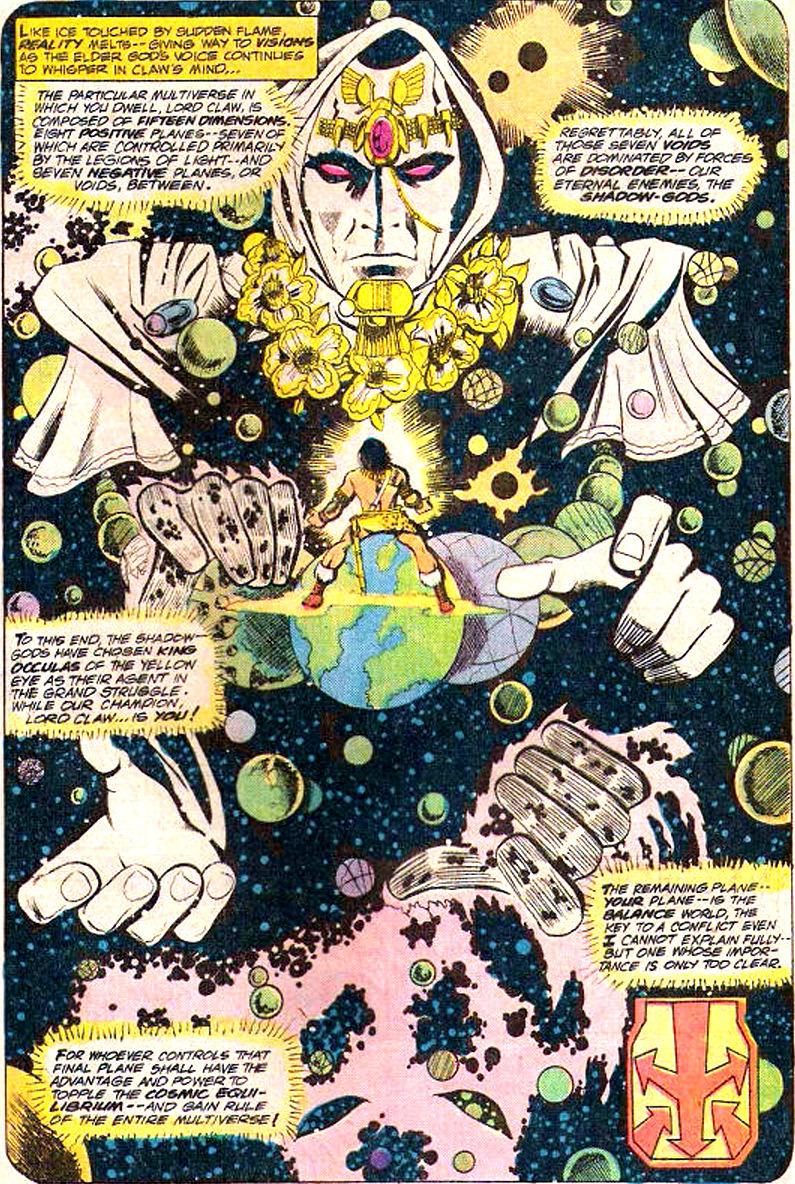
New Gods for Old

Art by Jack Kirby

While I have always been more enthusiastic about the standard (A)D&D Cosmology compared to a lot of people, one thing has always bothered me about it: the shoehorning in of the various mythological figures from Deities & Demigods into the canonical version of a planes. Perhaps they were meant to merely placeholders for something you created, but I don't think they are ever discussed as such. The every god and the kitchen sink approach loses the flavor of the various mythologies, and undermines the unique (at least weirdly syncretic) flavor of the Great Wheel. I think they can for something new and much weirder.

But there's something else wrong. Geoffrey Grabowski (lead designer of Exalted 1e among other things) hits on it:

There are infinite infinite prime material planes. Well wow. Against that, even greater gods look tiny. Even if you give them plenty o' powers like Grubb's cosmogony does, or like the immortals rules that appear in some versions of the game do, they're still essentially the pantheon from Lord of Light. They might have a lot of superpowers from tapping into whatever god-power comes from -- possibly belief-energy? -- but they don't command their context. They're finite beings pretending to universal domain against a backdrop that makes their charade a joke if you have any distance on the tableau.

Nowhere in the canon planar materials do we get the feeling that these gods created the planes. Maybe they created one of an infinite number of Primes, but they are not the creators of the Outer Multiverse. They are its inhabitants. At best inheritors, at worst squatters.

It seems to me that what the D&D Planes need is either (a) new gods that are vast and strange, so that they seem reasonable creators of the vast, baroque, orrery in which they reside, (b) more Kirby New Gods/Thor-esque super-powered adventurers (i.e. the next level of the game. Immortals done right.), or (c) both.


Sunday, December 1, 2019

Weird Revisited: The Dead Travel Fast


In the deserts north of Heliotrope, weird monsters of the outer dark and thrill-crazy youths race hopped-up roadsters across dead sea bottoms.

In Hesperia, a “car culture” has emerged. Like the Southron bootleggers, some young Hesperian men have taken to modifying jalopies for the purpose of drag-racing. Most of the modifications are strictly mechanical, but would-be racers save up for more expensive thaumaturgical or alchemical modifications.

While some racing occurs along highways, the real action is out in the desert. There, on the vast and empty beds left by ancient seas, law enforcement doesn’t intrude, and higher speeds can be reached. The speeds, and the often haphazard modification of the cars, sometimes make these races deadly--but these mundane dangers aren't the only things to fear.

Maybe it was just the psychic energy boiling off youth hopped-up on alchemical drugs, speed, and the proximity of death; or maybe the death of the ancient seas left the skin of reality thin, inviting irruption. Whatever the cause, broken and burned-out husked of roadsters--and sometimes the charred and mangled remains of their drivers--have been reanimated by outer monstrosities in forms as colorful and grotesque as something from a drug delirium nightmare.

Appearances by these creatures are things of fear and wonder for the human racers. The unholy growl of giant engines and the overpowering smell of burning rubber presage their arrival--almost always between the stroke of midnight and first light of dawn. They're practically worshipped as secret and strange god-things. Rituals are performed; crude talismans of twisted steel and burnt chrome are fashioned. The bravest (or craziest) of the young drivers sometimes join in their monster races, and those few that survive with life and limb, and sanity, intact are often dragged along in the creatures' slipstreams as they roar back into the void, and are never seen again

Wednesday, November 27, 2019

Wednesday Comics: BABC Podcast: Korg 70,000 B.C. #9

I new episode of the Bronze Age Book Podcast is out! Listen to us ramble about Korg: 70,0000 B.C. #9 on your podcast app of choice!


Listen to "Episode 10: KORG: 70,000 B.C. #9" on Spreaker.

Monday, November 25, 2019

Weird Revisited: The Elements of Bronze Age Four-Color Fantasy

By Bronze Age, I mean the Bronze Age of Comics, which largely conicides with the 1970s. Any readers of this blog will know that's an era I have some affection for [since I now do a podcast on it!]--particularly its fantasy comics. These comics (particularly when original to the comics medium and not adaptation) present a flavor of fantasy distinct from other fantasy genres or media.

I feel like this sort of fantasy would make for a good game, and I don't think that's really been done. Warriors & Warlocks supposedly set up to do this, but that supplement really winds up adapting a wider range of fantasy to the Mutant & Mastermind system. I've been trying to think of the elements/tropes of this sort of thing:

1. Very much a “Points of Light” thing with large stretches of wilderness and clusters of civilization.

2. Cities tend to look more fantastic ancient world/Arabian Knights/Cecil B. Demille spectacle than grotty Medievalism

3. Above ground ruins and natural obstacles as more common adventure locales than underground “dungeons.”

4. Fantastic terrain is more common (because it makes for good visuals).

5. Magic-users generally fall into 1 of three categories: 1) almost god-like patrons (who maybe secretly be of Type 2); 2) villains; 3) bumbling,  sometimes comedic helpers, makers of anachronistic references.

6. Magic tends to be visual and flashy.

7. Elves and dwarves (or Elfs and Dwarfs, more likely) are more Disney and Keebler than Tolkien. They are less powerful than humans and perhaps comedy relief.

8. Beings that stand between humans and gods (like Tolkien elves) are either extremely rare, degenerate, or both.

9. Monsters tend to be unique or very uncommon (even if of a recognized “type”). There are seldom nonhuman territories. More fairy tale naturalism than Gygaxian naturalism.

10. Magic items are rare and tend to be unique.

11. Frequent faux-Lovecraftian references, but virtually no cosmicism.

12. Sometimes, there's a Moorcockian as filtered through Starlin sense of cosmic struggle.

13. Armor is as a signifier of profession/role (soldier) or intention (the hero goes to war) rather than actual protection.

This is not an exhaustive list, I'm sure, and it bears some overlap with pulp fantasy/sword & sorcery and fantasy/sword & sandal films that influenced it, and rpg fantasy that arose around the same time, but I think it has elements on emphasis distinct from those forms.

Friday, November 22, 2019

Down the Mean Streets of Neo-York

A gaming compatriot of mine has started up a new blog Neo-York Chronicles where he's detailing his vision of a cyberpunk future New York. It's good stuff. You should check it out and add it to your blog rolls!

Thursday, November 21, 2019

Shadows Fell

This post is a follow to a couple of previous posts during Exalted's Creation into a D&D setting.


The cosmos had not been constructed to parse the deaths of one of its creator Titans nor were the spiritual algorithms of reincarnation equipped to handle such complex beings. When the Titanomachy led to the exactly this outcome, Oblivion, a plane of negative energy, was manifest.

Theories differ as to the nature of this negative energy plane. Some believe it was formed by the collapse of the abliving yet undying souls of the slain Titans under their own gravity. Others hold that this collapse merely created a whole in the fabric of the cosmos allowing access to pre-existing Oblivion. Either way, the Underworld, a dark shadow of Creation, was generated on this puncture's event horizon.

The pull of Oblivion drew dead souls to it and kept them from the stream of Lethe, cosmic reincarnation function, creating ghosts and other undead for the first time. These creatures of Oblivion began to plague the mortal world. Most fearful of all of these are the Deathlords, powerful souls granted power by the Neverborn, the undead Titans, to serve as their agents in Creation, to prosecute their war against the living world.

The Deathlords often rule Shadowfells, places where the Underworld bleeds over into Creation, with their puissant soldiers, Deathknights. Thirteen Deathlords are believed to exist. Known Deathlords include Mask of Winters, Dowager of the Irreverent Vulgate in Unrent Veils, the Whispered One of the Rotted Tower, and The Count of Ravenloft. The last has the distinction of being the only lord to have a Deathknight rebel against him, the Knight of the Black Rose.

Monday, November 18, 2019

Brother to Dragons

This post is a follow to a couple of previous posts during Exalted's Creation into a D&D setting.


The Dragonborn, Princes of the Earth, rulers of Creation for over a millennia, are the descendants of the elders of dragonkind. Gaea, the Titan of Earth, was mother to The Dragon Ao [1], whose nature warred against itself until he split into Tiamat and Bahamut. The two represented the forces of chaos and order. The first progeny of Tiamat were the elders of the chromatic dragons, while Bahamut's children were the metallic dragons.

The elder dragons, both metallic and chromatic, bore human children, who carried a portion of draconic power. Those who carried the most draconic power were transformed by it and were able to take on the form of a humanoid dragon [2]. Those with a weaker, but still potent connection, became sorcerers. The Dragonborn and their sorcerer kin were the soldiers of the gods in the Titanomachy. This estranged the chromatic Dragonborn from their grandmother, Tiamat, who sided with the Titans and was imprisoned in Hell with them following their defeat [3].

Today, the Dragonborn rule a vast Empire (though less vast than it was in the past). They are organized into Great Houses, one for each of the types of metallic and chromatic dragons.


1 D&D sources report this name as "Io." This seems better to me.
2 I figure these Dragonborn would have a human/mostly human form as well as the draconid form.
3 D&D tradition places her on the first layer of Hell.

Sunday, November 17, 2019

Weird Revisited: Back to the Strange Stone Age

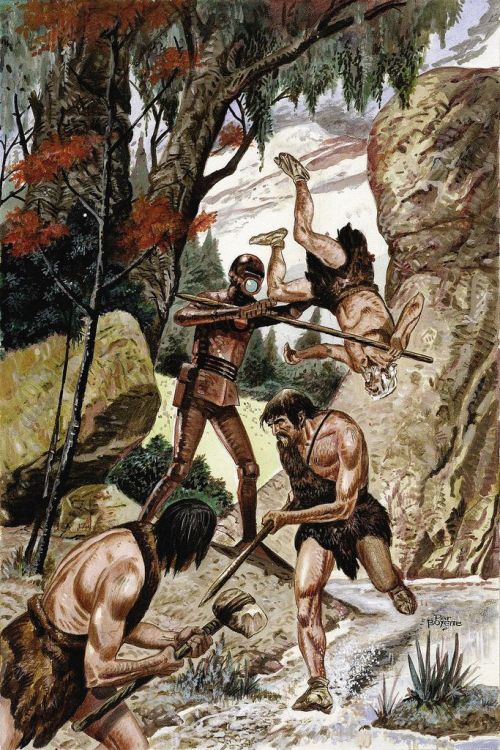
Reading Korg 70,000 B.C. for an upcoming podcast reminded me of this post from 2015.


Or maybe forward to a remote future? Whichever, it's a time where prehistoric humans do battle with monsters--both known to history and unknown--and with incursion of aliens or ultraterrestrials, part Kirby and part von Däniken. The actions of the aliens create sores in the skin of reality where the normal laws are warped and disrupted.

Some humans have benefited (or so they believe) from alien technology and even interbreeding. They view themselves as superior to the others and hunt them for slaves--or worse. But humans have allies, too: the gregarious Small-Folk (Halflings, pakuni, homo florensis), the hardy and aloof Stone Folk (dwarves, T'lan Imass, Neanderthals). And then there are the spirits, made stronger since the aliens rent holes in reality, with whom the shamans intercede through the use of sacred, hallucinogenic technologies--their "passkeys" into the operating system of the universe.


Inspirations:
Comics: Devil Dinosaur, Tor, Tragg and the Sky-Gods, Henga (Yor), Turok, anything New Gods by Kirby or Morrison (for the "magic as technology" aspect).
Fiction: Karl Edward Wagner's Kane stories (mainly the implied pseudo-scientific background), Manly Wade Wellman's Hok, Roadside Picnic (the portrayal of zones and alien artifacts)
"Nonfiction": alien abduction stuff and forteana, "forbidden history" stuff, Chariots of the Gods.

Friday, November 15, 2019

The Planes of Exalted [Exalted/D&D Mashup]


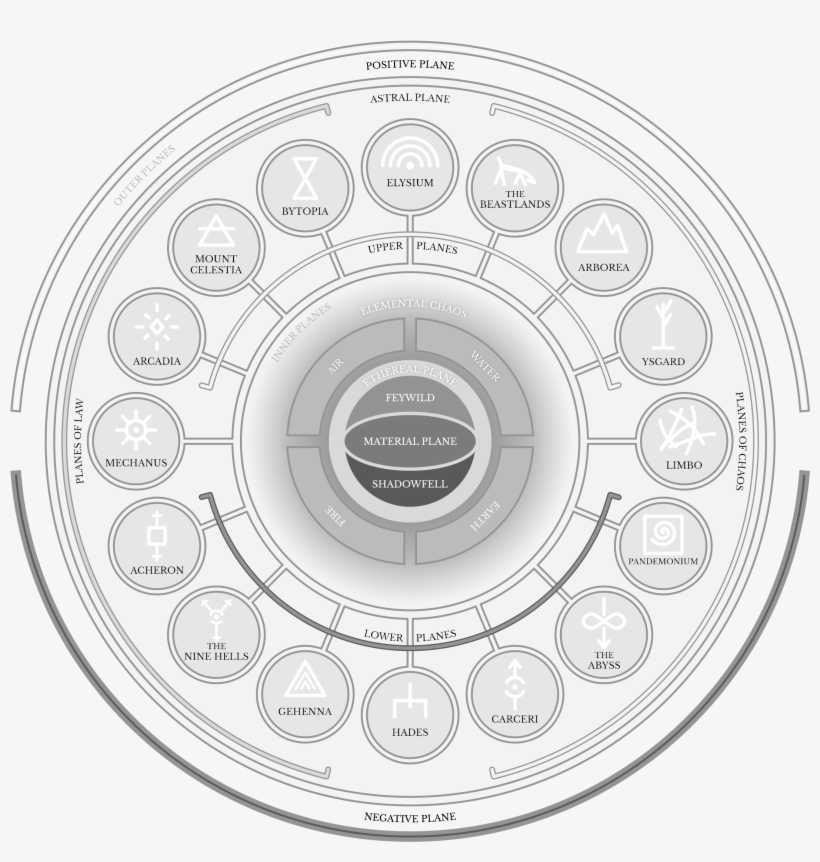
Some thoughts on social media by Jack Shear reminded me of this old post, with Jack suggesting replacing elements of the Exalted setting with rough analogs from D&Ds implied setting. As most things D&Dish do, this inevitably got my thinking about the planes and how one could break the Great Wheel in Exaltedish pieces. 5e's cosmology even starts doing some of the work.

Yu-Shan: Exalted's Heaven, a continent-sized city. Much of it would resemble part's of D&D's Mount Celestia, but some of it's nation-sized parks would be like The Beastlands. The Celestial Bureaucracy would have elements of Mechanus (including Modrons and Inevitables).

The Wyld: The Chaos outside and encrouching on Creation. Pure Chaos is probably not something worth getting into (maybe it's like the D&D Far Realm?), but the middlemarches are like D&D's Limbo and home to Slaadi. Maybe there is an area of Pandemonium, too. We might as well call the bordermarches the Feywild, but they also include elements of Arborea the "deeper" you get.

The Underworld: This occupies the position in relation to the Prime Material Plane/Creation as the Shadowfell, but they term should be applied to the areas Exalted calls Shadowlands, where the Underworld and the Prime overlap. The Underworld proper should get a lot of Hades/Grey Wastes stuff, and beneath it is Oblivion, the Negative Energy Plane.

Malfeas: The prison of the Yozi's (the Primordials betrayed by the gods) would by the repository of much of the Lower Planes stuff: the Abyss, Carceri, and the Nine Hells. The Law and Chaos division of these worlds in D&D terms would be a hindrance to making them more like Exalted, so maybe that's dropped, or maybe demons and devils are different factions of Yozi.

Autochthonia: The world within the body of the Primordial Autochthon. Mechanus is a better name for this god and this place anyway, so whatever Mechanus stuff wasn't shunted to Yu-Shan should be here. Also, some of the old quasi- and para-elemental planes would be the elemental "reserviors" of this world (Smoke, Radiance, Lightning, Mineral, etc.)

Wednesday, November 13, 2019

Wednesday Comics: BABC Defenders #34

A new episode of the Bronze Age Book Club podcast is available! Check it out here on on your podcast app of choice.


Listen to "Episode 9: DEFENDERS #34" on Spreaker.

Monday, November 11, 2019

The Vault Job


Our Land of Azurth 5e campaign continued last night with the party meeting with the former mayor, Gladhand in an underground hideout. Gladhand wants their help ousting the new mayor who has apparently becoming something of a despot. Gladhand claims to have a stash of gold he can use to hire mercenaries, but he needs the party to get it for him.

He had entrusted the money to the Sly Took, a member of the Raccoon Folk Thieves Guild and operator of a vault where people can keep valuables they want to stay hidden. The vault is protected by a cadre of elite rat folk mercenaries and apparently some vicious weasels--and has very high security.

The party is unsure whether they should help Gladhand or not. While the current mayor was supported by another adventuring party who the group feels has stolen their thunder, they know Gladhand to be something of a crook, and the vault sounds pretty difficult to get into. Ultimately, the greedier members of the party carry the day, and they at least agree to look into the job.

Waylon uses some underworld contacts to inquire about stashing some money and potentially some magic items in the vault. He uses this visit to case the joint as well as he can. Security is indeed high, with traps, arcane locks, and requirements for 3 magic key charms for each one.

Unsure of how best to approach things, the party contemplates a frontal assault, while acknowledging this seems like a bad idea...

TO BE CONTINUED

Friday, November 8, 2019

Weird Revisited: Five Kooky Cults

I came upon this post when searching for another one. I had forgotten some of these (this post was original presented in 2011), so it seemed worth a revisit... 

Here are a few minority religious groups seen at least as bit odd (if not outright dangerous) by the majority of the City's citizens:


The Abattoir Cult: Secret followers of the sinister and bloody-handed Lord of the Cleaver. A liturgical text (anthropodermically bound) honoring this obscure eikone is known to exist in a private collection in New Lludd. His cult tends to crop up in districts devoted to meatpacking or slaughter pens and is associated with the emergence of serial killers.

The Temple of Father Eliah Exalted: This Old Time Religion sect preaches racial and gender equality, chastity--and the godhood of its prophet, Father Eliah Exalted. The Temple owns a number of groceries, gas stations, hotels, and other business. These are ostensibly held by acolytes but seem mainly to enrich the Father. The Temple is politically active and the Father’s support can sway elections. Many are suspicious that Exalted’s powers of oratory and occasional miracles suggest that he is one of the Gifted or perhaps a secret thaumaturgist, but proof has been hard to come by.

Serpent-spotters: An informal collection of people forgotten by society--mostly poor and elderly spinsters and widowers--who are convinced that the monster that appeared in the Eldritch River 30 years ago, and supposedly delivered secret prophecies to City fathers, will return, heralding the apocalypse. On days individually chosen they hold vigil in Eldside Park. They hope to be present at the time of the serpent’s return so it will reward their faith with a ride on his back to a watery Paradise.

The Electrovangelic Church of the Machine Messiah: A worldwide movement dedicated to building the perfect construct to manifest the Messiah and usher in a new age of mechanical spiritual perfection.

The Followers of the Rabbit: Not an organized religion, but instead a collection of superstitions and cautionary urban legends forming a secret liturgy for some folk working along the boardwalk of Lapin Isle. They hope to placate the godling of the island, the dark personification of the rabbit in the moon--the man in the rabbit suit that is not a man.

Wednesday, November 6, 2019

Wednesday Comics: Two Collections from Roger Langridge

Roger Langridge is Harvey and Eisner award winning comics writer and artist from New Zealand who tends to work in a quirky cartoon sort of vein (though he has written Thor and did a sort of surreal strip in Judge Dredd Magazine called Straightjacket Fits). Here are a couple of his works I've read that I would recommend:

Criminy
Written by Ryan Ferrier with art by Langridge tells the story of the Criminy family who looks sort of like Bosko (and sort of like the Animaniacs) who get into a series of fantastic adventures after their are forced to flee their island home by invading pirates. Criminy is aimed at younger readers (though might be more intense in places that strictly kiddie comics), but enjoyable by older ones, too.

Popeye vol. 1
IDW's 2012 Popeye series was written by Langridge with art by several different artists who do pitch perfect renditions of the Thimble Theatre characters to match the stories recalling the classic Dell Comics of Sagendorf. There were 3 volumes, all now available in hardcopy or on Kindle/Comixoloyu.

Monday, November 4, 2019

Well Blow Me Down! Popeye Maps

I'm not sure what iteration of Popeye this is from, but it suggests Popeye lives in a pretty small town:


Here's one definitely from the Sagendorf comics. At least Wimpy owns his on home in this version:


Friday, November 1, 2019

Black Iron Prisoners' Dilemma


Not even the solipsist monsters of the Abyss can continue forever under conditions of ever-changing insanity; some ideas produce too great a gravity for even the the most fluid minds to escape. And so, like a body faced with cells that might mutate beyond restraint, the Abyss walled off the offending ideas in a cyst. The cyst endures in the astral nothingness, holding its dark enlightenment within. This is the Black Iron Prison.

The pull of the Black Iron Prison attracts others. Monsters of the Abyss convinced that something besides Self was real and that something was Punishment. But by whom? The Godhead who had appeared to have forsaken them or some new Godhead yet to come?

Fearful and paranoid, the monsters elaborated prisons around the original one like nested labyrinths. There they hid, and interrogated and punished themselves and any other souls that fell into their grasp.

Some might consider the multiverse's largest prison a place of Law, but there is little Law here. Rules are arbitrary and changeable. As are punishments. All the jailers operating under vague authority are just more prisoners. Those jailers, the prisoners with the longest sentences, are the fiends called deodands, this name being an an ancient term for an object which has caused a death and so is forfeit to God. If anyone knows why the fiends have this name it is the Baatezu, and like most secrets, they have classified the information.

The most common deodands are tall, emaciated, scabrous creatures with frog-like mouths. Their bare skins weep a tarry ichor from numerous injection sites. They're junkies and dealers; they mix the astral excreta of despair, callousness, and fear that oozes from the souls that fall into their hands with the bile of arthropods that make their homes in the prison’s substructure and inject it beneath their skin. The tarry substance--and a brief respite from their paranoia in a cold, sneering high--are the result. The tar is packaged and sold (to the prisoners to be smoked or injected) in exchange for pleasant memories or dreams or hopes--anything that defines the former self-hood of the soul. When not engaged in commerce, these tar deodands are the menials of the prison.

The the second most common variety are the color of a fresh bruise.  Their limbs are swollen like blood sausages, and their tick-like bellies appear filled to near bursting, sloshing loathsomely as they waddle or fly drunkenly on ridiculously small wings. Their bloated faces are unpleasantly human-like and wear expressions of voluptuous satiety, complete with drool running from the corners of their mouths and down their double (or triple) chins. Always their skins appear to glisten as if oiled. They sweat even more when they eat, and they eat almost constantly. The eat when they are worried, and they are always worried. About informers or conspiracies. About a time when the tortures they apply to others might be applied to them.

The rarest of deodands have assumed the most authority. They often pass themselves off as wardens and are just as often found in solitary confinement. They sometimes watch and titter at the interrogations as they undergo torture themselves. They’re androgynous humanoids with bald heads and unfeminine faces, but pendulous breasts and high-pitched voices. Their pale, wrinkled skin seems ill-fitted to their bodies. They have a penchant for dressing in uniforms, the more elaborate the better. Sagging deodands, they are called.

Thursday, October 31, 2019

The Halloween Special


And of course, it's a repeat! Sorry, still no Fall Guy or Elvira actually in this post. I didn't do any Halloween related posts this year, but just sit back and relive these horror-themed classics:

Need a name for a horror comic? Generate it with this post.
Ever heard the legend Spring-hilled Jack? Well here are his stats.
A different way of the thinking of Ghost Towns, from Weird Adventures, but usable anywhere.
And finally, a 2013 Santacore request unwittingly opens, "The Tome of Draculas!"

Wednesday, October 30, 2019

Wednesday Comics: Bronze Age Book Club: Monsters Unleashed!


The latest episode of the Bronze Age Book Club podcast is available, just in time for Halloween!

Listen to "Episode 8: MONSTERS UNLEASHED (1973) #2" on Spreaker.

It's also now available on Podcast Addict!

Monday, October 28, 2019

The Rolling City and the Devil Sun

This post is in response to a challenge from Anne at DIY & Dragons based on this post a the Githyanki Diaspora from 2009 suggesting an easy way to "Make Your Own New Crobuzon."


The Last City
Clacking, rumbling, the city moves. It rolls through the night on sixteen indestructible rails carved from the bones of dead gods. The shanties on its ziggurat steps rattle; it's bristle of towers sways. The city never stops for long, and it always stays ahead of the dawn. It's being chased by a vengeful god, the Sun.

The Devil Sun
There is a face in the green Sun, and it looks down on the world it hates with grinning, idiot malice. It chases the city across the face of the blighted world, through the ruined cities of the elder days. Where its morning light shines, its energy creates cancer jungles and fleshy masses of monsters. Even these wither and die under the force of its noon regard, leaving only blasted desert in the dying light of evening. The Devil Sun would destroy the clanking redoubt of the city, too, but it moves too slowly across the sky to catch it. For now.

Three Minor Humanoid Races
Xixchil once had their own city, but it was lost, and they bought their passage on the last city with their art. It was the Xixchil surgeons that developed the Warforged. The Xixchil are mistrusted because they live in enclaves of their own and practice secret rituals they do not allow others to see.

The Warforged were made to be the city's soldiers. There are many fewer now than there once were. They are officially accorded respect for their service, but many former refugees blame them for the loss of their old homes.

Athasian aarakocra live in the precarious high towers of the city. They are scouts and foragers.

Three Monsters
Clockwork automata serve in every level of the city, particularly performing jobs around the engines or on the city's undercarriage where living things can't go. Some damaged automata become rampaging clockwork horrors.

Obliviax is cultivated in some labs in the city for it's various memory uses: to fashion an anti-senility drug, to steal memories, or simply to make people forget. It has escaped and grows wild in some lower levels.

Arcane oozes sometimes crawl up the cities exterior. The gorge themselves to a torpor on the divine magic that powers the city. Sometimes they become a hazard and must be removed.

Friday, October 25, 2019

Weird Revisted: The Secret Life Stages of Elves

This post from 2016 is more recent than my usual revisits, but I had forgotten about it, only coming across it while looking for another post and thought it was worth a reshare...


What humans mistake as different tribes or clades of elves are actually different stages in their millennia long, perhap endless, lives.

Wood elves are elven adolescents. They rebel against their parents and go to live in bands of others of their age. They throw racuous parties in the woods and experiment with intoxicants. They are capricious, emotional, and cliqueish. Their tribes run the gamut between Woodstock and Lord of the Flies.

High elves are elven adults. They interact most with other species and are responsible for the maintenance of elven civilization. It is in this age cohort that the immortality of elves begans to take its toll, however. Elven brains are not structurally that different from humans. They do not have the capacity to hold countless centuries of memories. Their initial compensatory mechanism is monomania. Elves develop a strong interest that narrows the array of factual information they must recall and provides constant reinforcement for the things they find important. Some become swordsmasters, some master artists or craftsmen, some archmages.

For some elves this is enough, and they grow more skilled, more focused, and stranger, until they become almost demigods in their chosen vocation. These are the Gray.

Others, though, are not able to maintain such focus. Something akin to dementia sets in. They become forgetful, and paranoid. As they begin to lose their past--lose themselves. They find only intense linger long. These are the drow, the dark elves.

Dark because of the darkness that consumes their minds; dark for the deeds they commit to hold on to self and not slip into endless reverie. They go to live in the dungeons of their kind to pursue intense pleasures and horrors or simply howl or cackle in the darkness. These elders are feared by other elves. They avoid them and will not reveal their relationship to them to non-elves.

Thursday, October 24, 2019

A Premise for Opposing Planes


I'm planning on expanding on the version of the Outer Planes posited by these two posts.  In brief, the planes are reframed in a sort of gnostic background wherein Law and Chaos relate to competing ideas about how best to restore unity with the Godhead. I like this idea because it gives a structure to hang both Law and Chaos on and the other various flavors radiating out from these "poles."

Good and Evil don't carry quite the same weight. Instead, they are shorthand for approaches for dealing with the opposing side. Lawful Good seeks accommodation with Chaos and peaceful conversion where possible; Lawful Evil feels there is no compromise with Chaos and force is always an option. This is not an idea new to me. It's hinted at the the Planescape material, and I've seen if discussed on forums. Adding the layer of competing visions of the Godhead adds something extra.

Anyway, more to come.

Monday, October 21, 2019

What The Clockwork Princess Said

Our 5e Land of Azurth campaign continued last night (now in its fifth year!) with the party trying to get some information from the the tree-like mass of gears and wires that bore the face of the former Princess of Yanth Country, Viola. They couldn't make much from her comments.  Was she merely repeating words from their questions or genuinely answering? They did think they got the phrases: "Not trust", "Queen Desira", and "Find. Now." Those may or may not have been related thoughts.

Suddenly, there was a flash of light in the hallway, and a mysterious stranger in a long coat with a flying-V guitar slung across his back stepped into the room. For some reason, the party immediately assumed this was "Future Kully," though the Kully of this time was supposed to be dead. The stranger seemed flustered by their questions about his identity, noting that he wouldn't have worn a bandana over his face if he wanted it to be known. He told them they needed to return to their own time, and quickly, because "the forces of darkness" were coming. He invoked concerns about effecting the future were he to answer any of their quite reasonable questions. He would say of his own origins: he was from "their future, but also from the distant past." He left the room playing his guitar and disappeared in another flash.

The stranger's words soon proved true, as the castle rocked as if struck. The party decided it was time to escape. A giant, insectoid creature of clicking metal and whirring gears broke through the wall, but after favoring them with a scream like an approaching train, turned and stumbled its way in the direction the party had come from.

They made it down two levels. The crazy gnomes were now fleeing with them. They exited the front door and saw two dragons blacker than the night sky, smoky and insubstantial around their extremities, circling like hawks overhead.

The party featherfall-ed (featherfell?) to the ground below. They saw black-armored riders on weird, loping steeds like hairless dogs with monstrous, human faces. They sprinted out of the clearing into a nearby stand of trees. Two riders peeled off from the many body and trotted over to the wood. Keeping a distance, one shot an arrow high. It transformed into a mass of arrows burning with green flame. The volley fell upon the party, seriously injuring Kairon and Shade. Again, the party ran for the deeper woods.

There, Phosphoro (finally) appeared, expressing regret for having forgotten to bring them back to their own time until now.

Back in Rivertown, the party discovered there have been some changes in their time away. A new palisade is around most of the city and there is a greater guard presence. They return to the Dove Inn and find their rooms are still intact, but they have back rent to pay.

When they see the innkeeper slip a note to a young boy, Waylon follows him through the streets. The boy goes to the house of Inkwell, the former bookkeeper to the former mayor. Inkwell returns to the inn looking for the party and asks them to meet him at his house this evening--and be careful of being followed.

That night, Inkwell tells them what has passed in the year they have been absent. Drumpf was elected mayor and used both his wizardly family and alleged aid from the land of Noxia to the North to enforce his rule in Rivertown. Gladhand, the former mayor, is in hiding, but Inkwell says he will offer the party a share in a large treasure if they will help him use the money to hire mercenaries to help drive Drumpf from the city. The party agrees to meet Gladhand.

Art by Jason Sholtis

Sunday, October 20, 2019

From Pole to Pole


While doing some research of the origins of the Ethereal Plane as a concept, I came across what I believe to be the origins of the Positive and Negative Energy Planes. The writings of "Christian Rosicrucian" Max Haindel describe the etheric regions composed of four different ethers. Each of these has a positive and negative pole. Though these bear little resemblance to the positive and negative planes (beyond the positive being associated with generativity and vitality) the planes are positioned over the Prime (and the Ethereal) in a manner than would suggest poles.

Of course, it's entirely possible that these were independent creations, but given that Theosophic publications seem to be the primary source of the Ethereal Plane, it doesn't seem like a stretch that that other esoteric writings of the same era might have provided some inspiration.