Friday, July 2, 2010

Weird Weapons, Weird War

The object of war is not to die for your country but to make the other bastard die for his."

- Gen. George S. Patton
When the crazy-quilt patchwork of nations that was Ealderde erupted in the Great War, a number of new technologies were brought to bear. Thaumaturgical and alchemical weapons and "weaponizable" advances were among these, and were utilized on a scale never seen before--with long-lasting, and terrible consequences.

First among these was the use of alchemical weapons, particularly gas. The forces of Neustria were the first to utilize them with fragmentation shells filled with stinking cloud potions. The Staarkish army soon escalated to lethal chemicals. Their "Magic Corps Men" cast cloudkill which, as a heavier than air gas, was ideal for filling enemy trenches. Since mages are a quirky lot, generally ill-suited to military discipline, their numbers in the Staarkish forces were small, and it proved expedient to replace them with thaumaturgic shells which could be fired from artillery at a greater distance.  The gas could also be pumped out of tubes, if the wind directions were right. Soon these methods were adopted by all the larger nations.

Other, more exotic chemicals were tried. Acid fog was released from sprayers to discourage attackers or soften defenders. Yellow musk, the pollen of the eponymous creeper, cultivated in secure greenhouses, was used to entrance enemies and make them easy targets. Amorphing solutions delivered via artillery shells sowed terror by making flesh malleable, dissolving limbs or even melting soldier's together. The only limits were the imaginations (and funding) of the alchemists and thaumaturgic engineers.

Magical weapons of mass destruction were also employed, and could be delivered to distant targets through the use of artillery and airships. Thaumaturgical explosives and blights laid waste to cities and farmlands. Rays of searing light, or jets of intense cold fired from zeppelins cut swaths of destruction across enemy trenches. Implosive weapons literally collapsed fortifications--or hapless troops--in on themselves.

Then there were the weapons calculated to cause as much terror as direct damage. Teleportation beams were turned upon population centers. Fear rays lead to mass panic. The battlefield fallen were briefly animated to turn on their grieving comrades. This is to say nothing of the even more exotic reality-warping weapons which, though rare, were powerful enough to disrupt the elemental fields to this day.

Another technological change in the Great War was touted as potentially rendering the human soldier obselete. Constructs and automata have been used before, but never in such a scale. "Land ironclads" or "landships"--now colloquially called "tanks"--were an innovation by the army of Grand Ludd on thaumaturgical techniques used to make anthropomorphic golems. Some tanks required human operators, but others were automonous to a degree, like the golems. This proved to be another one of the mistakes of war, as man-hunting kill-machines still roam the blasted former battlefields and depopulated wastes of Ealderde.


Man-shaped golems were still used--largely for their flexibility and, in some cases, greater psychological effect on the enemy--but these were produced with greater mechanical skill, giving them a wider variety of uses. Once again terror was a prime goal, as squads of murderous constructs with the appearance of children's toys were sent into unsuspecting villages in the dead of night. 

It's the hope of many that the most lasting innovation of the conflict will be that man has finally had enough of war. Certainly, the devastation wrought in Ealderde, and the refugees that still pour into the New World to escape the post-war horror, ought to be powerful reinforcers for such a lesson. Still, as the cynics among us would point out, no one has ever lost money betting on the short-memory or long-term foolishness of mankind.

Thursday, July 1, 2010

Trouble So Hard

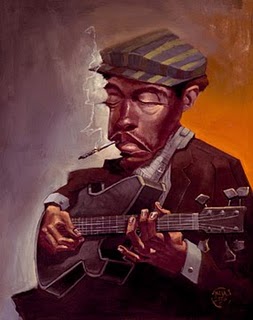
The so-called black folk are old acquaintances of hardship. From ancient slavery to modern discrimination, mistrust, and even sporadic pogroms, they have endured--even prospered--still clinging to their old customs. The Ealderdish-descended majority stereotype them as lazy, ignorant, and superstitious. It's a common belief that they are cursed as a people.

Ironically, the ancient stories and songs of black folk might agree, after a fashion.

Black folk are found throughout the continent, but are most common in the South, where they were once enslaved by the giantish Ancients, and the City and the Steel League, where they have migrated in more recent times to find work. The City neighborhood of Solace in particular is the cultural capital of the Black New World.  They remain something of a people apart, and tend to settle in their own enclaves, in no small part because it provides them some degree of protection from wider society. There, in secret, they can tell stories of the ancient days, before the calamity that befell them.

Long ago when the black folk spoke one tongue--and not the tongue of the Ealderdish invaders--they called themselves "The True People." They first enterered Ealderdish history when merhcant-explorers came to their continent and named it "Ebon-Land," not for its peoples' skin tones, but for the strong, dark wood they found there. The folk were primitive, though there were scattered, enigmatic ruins of a more advanced culture--one the Ealderdish were certain couldn't have arisen natively.

They met them again on islands off the New World, and in the South, where the black folk had been brought by the Ancients to toil in the construction of their tomb-mounds, and underground cities. The ancients were gone, and the black folk, like the Natives, were seen as squatters in the ruins of a greater race. The Ealderdish tolerated them (mostly), but didn't trust these people who kept to themselves, and knew powerful magics.

The Ealderdish may have not remembered the black folk, but the black folk remembered them. Their old campfire tales and songs recalled what they see as the true history of the world, a history the infant cultures of Ealderde have never known.

Once Ebon-Land held the greatest civilization in the world, their tales say, but that civilization was at war with the rapacious people of now sunken Meropis. Though Ebon-Land was more advanced in art and philosophy, Meropis surpassed them in the arts of war. Their wizards worked mighty magics not just to destroy Ebon-Land, but to wipe it from history. Even with Ebon-Land's strong defenses, the ritual was horrifically effective. Only a few now-anomalous ruins were left of a once mighty culture. And only the strongest willed of the black folk even remembered the past that had been taken from them.

So those who remembered told their people's stories, and saw to it that they were passed down over the generations. The stories also warned of the results of the depraved experiments of Meropis--where its sorcerer-scientists had sought to create a race of soldiers by crossbreeding humans with the subhuman stock of the northern forests. With Meropis gone, the savage, half-human tribes spread out over the land they would come to call the Old World, Ealderde, never guessing how young it truly was.

Wednesday, June 30, 2010

Warlord Wednesday: Blood Moon

And now, let's re-enter the lost world with another installment of my issue by issue examination of DC Comic's Warlord, the earlier installments of which can be found here...

"The Quest, Part III: Blood Moon"
Warlord (vol. 1) #18 (February 1979)

Written and Pencilled by Mike Grell; Inked by Vince Colletta

Synopsis: The desert behind them, Morgan and Tara now ride through the jungle, still on their quest to find Deimos--and Joshua. Morgan hopes that the magical crystal he took from Timgad will be helpful in defeating the power of Deimos--though he doesn't know how.

Such thoughts will have to wait, however, as the riders come upon (yet another) orange carnosaur. Morgan's horse gets spooked and throws him, so Tara pulls him up behind her. The hungry dinosaur is close behind.

When they ride into a wide swath of destruction cut into the jungle, the carnosaur inexplicably gives up and turns tail. That's fortunate for our heroes, because Tara's horse steps in a hole, and breaks a leg. Morgan is forced to put the horse out of its misery with his pistol.  So occupied, our heroes don't notice the incredible thing coming up behind them, until it is all but upon them.

They turn to see a red, crater-pocked planetoid--a moon--filling the sky as it travels the path it cut in the jungle. Before the two can react, men on sky-sleds emerge from it, and start firing energy blasts at them. Our heroes manage to destroy a few of the craft, but first Shadow falls, then her owners. Beams from the remaining sleds lift them and carry them into the moon.

They awaken in the presence of the eccentrically dressed Bornaa. He explains that what Morgan took for a moon is actually the cratered, protective shielding of a starship from the planet Alces Shirasi. The crew is all that remains of their billion year-old, interplanetary civilization, destroyed when their sun went supernova. In truth, they are the descendants of those last survivors, who were forced to cross-breed with humans, captured and genetically transmutated for that purpose. Now, they are close to being able to breed with unaltered humanity, and then they will be able spread their civilization and culture throughout Skartaris. Bornaa expects Morgan and Tara to take part in his people's plan.

Morgan declines--and not so politely, as he leaps forward to throttle Bornaa. Our heroes try to flee, but Bornaa manages to trap them in a force field. They lock Morgan in their transmutation machine. "If he insists on acting like a savage beast," Bornaa explains to Tara. "It's only fitting that he look the part as well." Bornaa leads the horrified Tara away, and the machine turns Morgan into a bull-headed creature. As his rational mind slips away, his strength surges and he breaks free.

Meanwhile, Bornaa is putting the moves on Tara with lines like: "I am much higher on the evolutionary scale." Tara plays along only long enough to steal his pistol and blast him. She runs back to save Morgan, and finds him fighting the crew, raging bull style. The voice of his beloved Tara soothes the savage beast and gets him back into the machine so the technician (at gun-point) can return him to normal. The two free Shadow from a nearby cage, then escape on sky-sleds.

An overzealous guard tries to stop their escape, but misses and hits the ship's reactor instead. Morgan and Tara escape, but the starship explodes as they look on from a distance, marking the final end to the Shirasi people.

Things to Notice:
  • Tara misquotes Saaba--she says the witch told them they could find Deimos "in a place of eternal shadow," but what she actually said was "a place of half-light, half-shadow."
  • Shadow, Tara's dog, is still with the pair.
  • The Shirasians may have pioneered that fundamental of United Federation of Planets chronometry--the stardate. 
Where It Comes From:
"Blood moon" is another name for the "hunter's moon" which is the first full moon after the harvest moon (the full moon nearest the autumnal equinox).

The use of a stardate in the Star Trek style, points to this issue's possible inspiration in the original series episode "For the World is Hollow and I Have Touched the Sky" which features a generation ship that appears to be an asteroid.

It's also possible that the idea that our moon is actually an alien spacecraft was at least part of the inspiration. This is the so-called "Spaceship Moon Theory" proposed by Vasin and Shcherbakov in a 1970 article, and popularized by Don Wilson in the 1975 book Our Mysterious Spaceship Moon.

Grell engages in a bit of a joke with the name of the alien invaders. "Alces Shirasi" is the species and subspecies name of the Shirasi Moose (Alces alces shirasi), the smallest species of moose--native to Morgan's home state of Wyoming. Perhaps this is sly reference to their penchant for human-ungulate mash-ups, or either Grell just thought it sounded cool.

Morgan's quip about being able to do beer commercials in his minotaur form references the famous Schlitz Malt Liquor TV ad campaign, beginning in 1972, that features a black Brahma bull rampaging through any place a Schlitz is opened. Morgan, having been in Skartaris since 1969, would be unaware of this bit of pop culture, but his line is not necessarily an anachronism since Schlitz Malt Liquor had featured a Minoan-esque bull-head on its label since its inception in 1963.