5 hours ago
Wednesday, May 20, 2020
Wednesday Comics: The Fourth World Reread Week 4
The story in New Gods #7 reveals the pact that had maintained a truce between New Genesis and Apokolips and the origins of Orion and Scott Free, infants exchanged to be raised on worlds not their own. Orion became a warrior for good, albeit one constantly challenged by his nature. Scott Free was given over to Granny Goodness to be trained to conformity, perhaps to become another cog in the Apokolips machine, except that his nature wins out and he escapes. Mister Miracle #7 (1971) has Scott and Barda return to Apokolips to face the horrors of their upbringing and its architect.
The social order of Apokolips is a little hard to fathom. On one hand, we are shown Granny's fascist training camp orphan where conformity and submersion of individuality is all important. On the other hand, the villains from Apokolips bedeviling the heroes of the Fourth World titles are a diverse, even eccentric, lot. It's unclear how many of the villains we see are a product of Granny's tutelage, but certainly Virmin Vundabar and at least some of the Female Furies seem to be.
I suspect some of the Apokolipsians (Doctor Bedlam, Desaad, Kanto) are products of the older, aristocratic society of Steppenwolf and Heggra that Darkseid has transformed into a fascist state. The others are probably the most "successful" graduates of Granny's schooling. These strong-willed enough to retain some individuality, while still being conditioned for Darkseid's service. This presumably is the outcome Darkseid intended for Scott Free. Unless the irony of the son of High Father being merely a faceless grunt in his army appealed to him. This seems unlikely to me, because Darkseid seems more calculating than pointlessly cruel.
Mister Miracle #7 gives us our most extended look yet at the hell that is Apokolips. It's an armed camp emblazoned with grim, fascistic slogans. Workers are dressed something like a combination of Medieval serfs and German work camp prisoners. Here, they're attacked by Kanto, an assassin who looks like he grabbed his style from the Italian Rennaissance. He's a man of honor after a fashion. He let's Free and Barda go out of respect. His sort of evil is out of place in the more mechanized, modern Apokolips.
Monday, May 18, 2020
Showdown in Dhoon
Our Land of Azurth game continued last night. The party sprang its ambush on the demon Porcus. After he cornered them in a side room, he surprised them by wanting to parley. On the condition they leave town, he revealed that he had nothing to do with the fay-flower blossoms and had only been summoned by the townsfolk cultists afterwards. He alleges the true culprit is a wizard from a neighboring town.
This is Dhoon on the banks of scenic Lake Dhoona. The party makes their way there and discovers the local lord, Lorn of Dhoon, has recently had a personality change and has been making some really nonsensical decrees. His latest sees dwarfs banished form the town under penalty of stretching on the rack.
Turns out there is no wizard in town anyone knows of, but there is a dark druid, high priest of the chaotic Church of the Dark Flower, named Slekt Zaad. That was the name Porcus gave them they couldn't remember!
Kully's got a plan to frame any mayhem on their rivals, Prof. Marvelo and the Eccentrics, while invoking Mayor Drumpf's name in a sting on Slekt Zaad. They go to the temple and get an audience with the high priest. He seems disinterested in their fake offer, but their dogged insistent regarding the fay-flowers eventually ticks him off. Slekt reveals his true face: he's some sort of plant man:
He has the doors shut by his guards, and even offers the party the first shots in the the throw down. None of this particularly worries them being a brave--or foolhardy--bunch. However. none of their attacks seem able to hurt Slekt Zaad. Eventually they switch tactics and grapple him. He can't escape, but they still can't hurt him!
His wizard ally shows up and tosses a fireball. Slekt is still threatening to kill them. Erekose is dragging the grappled high priest toward the door--but then he's paralyzed!
Sunday, May 17, 2020
Magic from the Machine
A post last week led to discussion of what constituted science fantasy. In discussion those admittedly ill-defined genre boundaries, I thought of one type that is fairly common in comic books but not that common elsewhere: the blurring of technology and magic.
This is not quite the same thing as Magitech, or perhaps more accurately it's a subtype of it. Magitech can be lame (or at least uninspired) stuff like magic carpet taxi cabs or soldiers armed with fireball shooting wands. I'm talking more things that have the appearance or origin of technological devices but seem to have effects that are magical. Jack Kirby employed a lot of this stuff, particularly in the New Gods, where the characters evolved from the remnants of mythological beings, but who possess and advanced technology of a sort. The Cosmic Cube is another such artifact as is the Miracle Machine in the Legion of Super-Heroes. Heaven is depicted as full of this sort of technology in Morrison's JLA.
I feel like this sort of aesthetic is ripe for use in rpgs. Maybe Exalted does some of this, perhaps Godbound, but mostly science fantasy in rpgs is pretty standard. I think it would be pretty easy too. Potentially as simple as reskinning magic items with a technological look and a few features.
Friday, May 15, 2020
Post-Apocalyptic Greyhawk
A great deal of change separates the North America of the 21st Century from the future age of the Free-City of Greyhawk, sitting on the ruins of ancient Chicago. The upheaval around the Anthropocene Thermal Maximum lead to mass migrations and alteration of the landscape. Four emerging peoples would be largely responsible for shaping civilization of the Greyhawk era.
The ancestors of the Bakluni were sea nomads and climate refugees from Asia who had settled on the southern Pacific Coast of North America. Pressure from groups fleeing north from the Tropic of Cancer led their culture in a more warlike direction--and also pushed them both east toward the Rockies and northward.
The Pacific Northwest was the domain of the Suel culture. It evolved in the main from separatist groups with racial supremacist leanings during the fracture of the United States and Canada. An upper-class of "pure-blooded" nobility ruled over a "mixed race" lower class in a feudal society. The inbred ruling class commonly displayed a unique mutation in melanogenesis that led to pigmentless skin and hair, and violet eyes.
The underclass of the Suel was similar (and indeed often derived from) the peoples of diverse ethnic origin that were the primary cultural group from the Rocky Mountains eastward. These were collectively known as the Flan, though they did not initial share any real concept of national identity. Most Flan lived in small, nomadic or semi-nomadic tribes.
The final group, the Oeridians, were a people of less certain origin, but they seem, like the Suel, to be derived from North Americans of European descent, but with genetic markers indicating a significant contribution from Native American ancestry. They were a tribal people known to both the Bakluni and Suel--and employed by them both as mercenaries.
Thursday, May 14, 2020
Weird Revisited: Scavengers of the Latter Ages
I think I might right another follow-up to this post, so it was worth revisiting from the distance past of 2018...
Here are some further refinements/elaborations on the idea I presented in a previous post for a 5e (or any sort of D&D really) game that was actually far future science fiction replicating fantasy.
![]() |
| Art by Bill Sienkiewicz |
Here are some further refinements/elaborations on the idea I presented in a previous post for a 5e (or any sort of D&D really) game that was actually far future science fiction replicating fantasy.
- The Distance Future: Millions of years certainly, though exactly how long is obscured by the mists of time and the humankin's fickle devotion to data storage formats. It is possible that biologic humanity even disappeared at one point but was resurrected by its nostalgic offspring. Scholars are aware that more than one civilization has come and gone and the Height was long ago.
- A Neglected Garden: Earth was once an intensively managed paradise, maintained by nanotechnology and AI that were integrated into the natural world. Most of the animals were heavily modified by genetic engineering and technology, and some were of exozootic stock. Even humans were integrated into this network, and everyone born still carries the nanotechnological system within them. Though technological spirits and godlings still live in nature, they no longer heed humans on any large scale, at least in part due to the fact that few humans can activate the necessary command codes.
- Diverse Humankin: Through genetic engineering, different clades of human-descended biologics have developed. The reasons for the modifications from baseline seen in these "races" may not always be apparent. Perhaps some were just art projects for some creative god?
![]() |
| Art by Laura Zuccheri |
- The grist: Commoners speak of "magic users" in dim memory of the fact that everyone of Earth is a "user" in the computer science sense, but wizards know there is no such thing as magic, only grist (or maybe mana), the shells of nanotechnology that envelope the world. Everyone uses it to a degree, but few have the aptitude to develop the skill to employ the grist to work wonders.
- The ether: The underlying grid of spimes and metadata, which supports the nano and once integrated it with the internet, is known as the Etheric Plane or Ether. Wizards and other magic users are aware it plays an important part in their spells and also in the powers of gods and incorporeal intelligences, but they are like mice within a palace, ignorant of its total function and potential.
- The Outer Planes: Civilization at the Height was not confined to the Primal Earth, but extended through the stars. Some of the posthumans that went to other stars disassembled planets to convert to computronium, then huddled close to stars for power. Their civilizations sometimes became very strange, perhaps even went mad. Many of their networks still connect to Primal Earth through ancient but robust relays. Humankin of Earth are often in grave danger when they venture into such places.
- Treasures Underground: Earth's current society is built on the detritus of millennia. Current humankin seek to exploit it in rudimentary ways, and more advanced civilizations of earlier times sought to do so in more advanced ways. The tunnels they dug still exist, but so do the guardians they put in place and the dangers they encountered.
Wednesday, May 13, 2020
Wednesday Comics: The Fourth World Reread Week 3
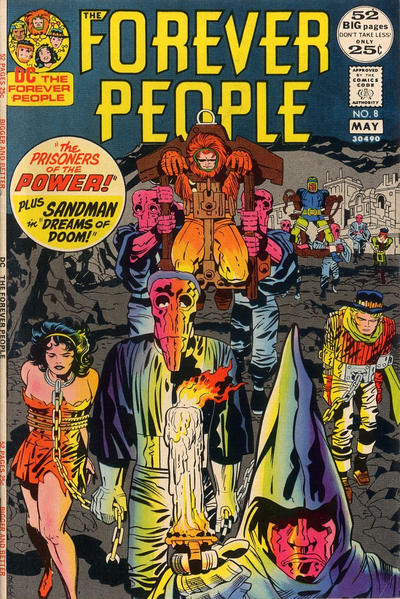
I had intended to talk about Mister Miracle #6 and Funky Flashman this week, but I just read Forever People #8 (on sale February 1972), and I feel like that better encapsulates the oddness of what Kirby was doing with the Fourth World saga.
There is a lot going on in this issue. A man known as Billion-Dollar Bates lives out in the desert with a barrier and deserted town guarded by para-military private security. He's involved with a Satanic cult called "The Sect" who has a ritual space beneath his mansion and wears weird looking masks. He's holding a group of prominent citizens against their will with some "power."
If that isn't enough, someone is infiltrating Bates' compound, wearing the masks of the Sect, and killing his guards. Then the Forever People show up.
Ultimately, we discover that Bates (like time-lost Sonny Sumo) has the "Anti-Life Equation," the innate ability to control minds. Unlike the virtuous Sumo, who worried about ever using the power, Bates has made himself wealth and powerful--and still has the desire to gloat to others about his deeds. It ends badly for him:
The inflitrators are Darkseid and his minions. And accident keeps Darkseid from the Anti-Life Equation: bullets through Bates. This is the second time Kirby has introduced the Equation in the flesh, and the second time he takes it off the table. Presumably he feels if it's ever here to stay he's reached the climax of his story.
With his ribbon tie, big cigar, and jowled face, Mister Bates is a rich man caricature. His very name hints at the self-gratifying nature of his use of the power and the way he has lived his life. He also fancied himself a "wheeler dealer," he tells his captives, but then the Sect revealed the true nature of his power. His life blessings almost literally derive from Satan.
The weirdest thing in this issue is, when confronted with the Forever People, Darkseid starts sort of playing drill sargeant and lines them up to berate them. Later Darkseid reveals it was a ruse to throw the Forever People off-guard, suggesting he fears them a bit. It's not at all how Darkseid is portrayed in the modern DCU.
There is a lot going on in this issue. A man known as Billion-Dollar Bates lives out in the desert with a barrier and deserted town guarded by para-military private security. He's involved with a Satanic cult called "The Sect" who has a ritual space beneath his mansion and wears weird looking masks. He's holding a group of prominent citizens against their will with some "power."
If that isn't enough, someone is infiltrating Bates' compound, wearing the masks of the Sect, and killing his guards. Then the Forever People show up.
Ultimately, we discover that Bates (like time-lost Sonny Sumo) has the "Anti-Life Equation," the innate ability to control minds. Unlike the virtuous Sumo, who worried about ever using the power, Bates has made himself wealth and powerful--and still has the desire to gloat to others about his deeds. It ends badly for him:
The inflitrators are Darkseid and his minions. And accident keeps Darkseid from the Anti-Life Equation: bullets through Bates. This is the second time Kirby has introduced the Equation in the flesh, and the second time he takes it off the table. Presumably he feels if it's ever here to stay he's reached the climax of his story.
With his ribbon tie, big cigar, and jowled face, Mister Bates is a rich man caricature. His very name hints at the self-gratifying nature of his use of the power and the way he has lived his life. He also fancied himself a "wheeler dealer," he tells his captives, but then the Sect revealed the true nature of his power. His life blessings almost literally derive from Satan.
The weirdest thing in this issue is, when confronted with the Forever People, Darkseid starts sort of playing drill sargeant and lines them up to berate them. Later Darkseid reveals it was a ruse to throw the Forever People off-guard, suggesting he fears them a bit. It's not at all how Darkseid is portrayed in the modern DCU.
Monday, May 11, 2020
Weird Revisited: The Hidden Country Setting
A significant number of works of fantasy take place in some sort of lost or hidden realm within the real world: Oz (at times), Neverwhere, Pellucidar, the Savage Land, Fraggle Rock, Hogwarts, and some versions of fairyland are all around here somewhere. This sort of setting doesn't seem to have been often used in fantasy rpgs, at least outside of modern/urban fantasy.
There are probably reasons for this. The Medieval(ish) nature of most fantasy gaming suggests a historical(ish) setting. The scale of most rpg settings would preclude them being tucked away in some corner of Earth. Perhaps there's also a fear with the modern world close by it would be too easy for it to intrude.
These seem to me to be only relative contraindications. Most gamers (at least of the old school variety) are comfortable with plenty of science fictional or science fantasy elements that violate the pseudo-historical milieu The scale may be sort of a problem (though Burroughs never let that stop him in Tarzan's Africa--and a Hollow Earth could have plenty of space) and a smaller scale setting isn't necessarily a bad thing.
This sort of setting opens up some new elements: Lost-like underground bases complete with enigmatic video instructions, modern world epherma as treasure, secret societies working in both "worlds." Pretty interesting stuff, I think, with a lot of potential.
Friday, May 8, 2020
Weird Revisited: The Strange Stone Age
This post first appeared in May of 2015...
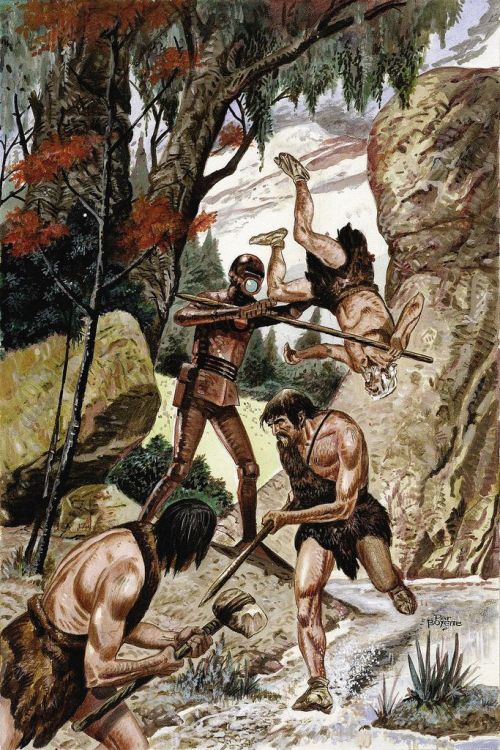
Or maybe forward to a remote future? Whichever, it's a time where prehistoric humans do battle with monsters--both known to history and unknown--and with incursion of aliens or ultraterrestrials, part Kirby and part von Däniken. The actions of the aliens create sores in the skin of reality where the normal laws are warped and disrupted.
Some humans have benefited (or so they believe) from alien technology and even interbreeding. They view themselves as superior to the others and hunt them for slaves--or worse. But humans have allies, too: the gregarious Small-Folk (Halflings, pakuni, homo florensis), the hardy and aloof Stone Folk (dwarves, T'lan Imass, Neanderthals). And then there are the spirits, made stronger since the aliens rent holes in reality, with whom the shamans intercede through the use of sacred, hallucinogenic technologies--their "passkeys" into the operating system of the universe.
Inspirations:
Comics: Devil Dinosaur, Tor, Tragg and the Sky-Gods, Henga (Yor), Turok, anything New Gods by Kirby or Morrison (for the "magic as technology" aspect).
Fiction: Karl Edward Wagner's Kane stories (mainly the implied pseudo-scientific background), Manly Wade Wellman's Hok, Roadside Picnic (the portrayal of zones and alien artifacts)
"Nonfiction": alien abduction stuff and forteana, "forbidden history" stuff, Chariots of the Gods.
Or maybe forward to a remote future? Whichever, it's a time where prehistoric humans do battle with monsters--both known to history and unknown--and with incursion of aliens or ultraterrestrials, part Kirby and part von Däniken. The actions of the aliens create sores in the skin of reality where the normal laws are warped and disrupted.
Some humans have benefited (or so they believe) from alien technology and even interbreeding. They view themselves as superior to the others and hunt them for slaves--or worse. But humans have allies, too: the gregarious Small-Folk (Halflings, pakuni, homo florensis), the hardy and aloof Stone Folk (dwarves, T'lan Imass, Neanderthals). And then there are the spirits, made stronger since the aliens rent holes in reality, with whom the shamans intercede through the use of sacred, hallucinogenic technologies--their "passkeys" into the operating system of the universe.
Inspirations:
Comics: Devil Dinosaur, Tor, Tragg and the Sky-Gods, Henga (Yor), Turok, anything New Gods by Kirby or Morrison (for the "magic as technology" aspect).
Fiction: Karl Edward Wagner's Kane stories (mainly the implied pseudo-scientific background), Manly Wade Wellman's Hok, Roadside Picnic (the portrayal of zones and alien artifacts)
"Nonfiction": alien abduction stuff and forteana, "forbidden history" stuff, Chariots of the Gods.
Thursday, May 7, 2020
The Thundarr Roadtrip
I ran across a podcast yesterday that is reviewing the the episodes of Thundarr the Barbarian in way that sensibly traces Thundarr and crew's travels across post-apocalyptic North America and beyond. It's called appropriately Thundarr Road.
Wednesday, May 6, 2020
Wednesday Comics: Fourth World Reread Week 2
One thing that virtually all of the continuations of the Fourth World saga by other hands seem to miss is that it isn't just a superhero action epic, but like all good mythologies, there are things going on beneath the surface.
New Gods #6 (on sale in October of 1971), continues Orion's struggle against the Deep Six, a group of Apokiliptian fishmen with the ability to mutate other lifeforms. They are not the best villains of the saga by any means, but Kirby uses them in issue 5 to reveal things about Orion, and in this issue, "Glory Boat!" to tell an allegorical story about war and its human cost.
The setup is almost Biblical. A great sea creature recalling Leviathan and all the primeval, Chaos monsters of the depths, a family, emblematic of humanity as a whole: the bellicose and overbearing father, the "conscientious objector" son, and the daughter who doesn't get to do much between the two's bickering. God of war Orion also has someone to play off here, his friend, Lightray, embodying the enlightenment of New Genesis.
Where Orion's instinct is to destroy his foes, Lightray strives to show a better way, to rehabilitate. He succeeds in transforming one of the Deep Sixes' creatures into the service of our heroes. Unfortunately, for the humans, the Deep Six are drawn back to the boat.
The father freezes, having some sort of breakdown when confronted with the creatures. The son, the peacenik, goes on the offensive, attacking the Apokoliptian Jafar. Jafars kills him, mutating his face into that of a featureless, metallic mannequin. Lightray opines that the war has taken "another faceless hero."
Lashed to the mast, the father bears witness to what is to come. Orion and Lightray take the son's body and launch themselves into a possibly final attack against the remaining Deep Three, in an epic two page spread.
But Lightray and Orion are not destine for some Neo-Vahalla, just yet. The boy goes "to the Source" and the New Gods live to fight another day. The father, still on the mast amid the wreckage of the ship is left to wonder as Kirby tells us: "What is a man in the last analysis--his philosophy or himself?"
It's heavy-handed perhaps, but no more so than work of the writers that would come to be seen as seminal figures of the 70s leading the "maturation" of comics.
New Gods #6 (on sale in October of 1971), continues Orion's struggle against the Deep Six, a group of Apokiliptian fishmen with the ability to mutate other lifeforms. They are not the best villains of the saga by any means, but Kirby uses them in issue 5 to reveal things about Orion, and in this issue, "Glory Boat!" to tell an allegorical story about war and its human cost.
The setup is almost Biblical. A great sea creature recalling Leviathan and all the primeval, Chaos monsters of the depths, a family, emblematic of humanity as a whole: the bellicose and overbearing father, the "conscientious objector" son, and the daughter who doesn't get to do much between the two's bickering. God of war Orion also has someone to play off here, his friend, Lightray, embodying the enlightenment of New Genesis.
Where Orion's instinct is to destroy his foes, Lightray strives to show a better way, to rehabilitate. He succeeds in transforming one of the Deep Sixes' creatures into the service of our heroes. Unfortunately, for the humans, the Deep Six are drawn back to the boat.
The father freezes, having some sort of breakdown when confronted with the creatures. The son, the peacenik, goes on the offensive, attacking the Apokoliptian Jafar. Jafars kills him, mutating his face into that of a featureless, metallic mannequin. Lightray opines that the war has taken "another faceless hero."
Lashed to the mast, the father bears witness to what is to come. Orion and Lightray take the son's body and launch themselves into a possibly final attack against the remaining Deep Three, in an epic two page spread.
But Lightray and Orion are not destine for some Neo-Vahalla, just yet. The boy goes "to the Source" and the New Gods live to fight another day. The father, still on the mast amid the wreckage of the ship is left to wonder as Kirby tells us: "What is a man in the last analysis--his philosophy or himself?"
It's heavy-handed perhaps, but no more so than work of the writers that would come to be seen as seminal figures of the 70s leading the "maturation" of comics.
Monday, May 4, 2020
The Power of Porcus
Our 5e Land of Azurth came continued last night. In the last adventure, the party had followed some robbed figures into passages beneath the town of Shkizz. There they fought some giant rats and found a door beyond which they could hear chanting. They tried to slowly open the door, but when it appeared stuck, they just forced it.
The robbed figures encircled a strange fire within a domed room carved from limestone. Above the fire hovered an anthropomorphic boar with undersized bird wings. One of the cultists sighted them, and the group demanded the party leave, as did the boar creature, Porcus, in a stuttering voice.
The party declined, and a melee ensued. The party dished out some damage, but Porcus was no slouch and soon Dagmar was down. Shade went to rescue their healer, but Porcus used their lack of focus as a chance to teleport out of the fight and slip into a secret door at the far end of the room. Our heroes, bloodied, had no appetite for chasing him
The cultists filed out past them with disapproving glances and remarks about both their jailbreak and their rude interruption of the meeting. The group let them go, then followed them back up to the surface.
Dawn was breaking. The party returned to their rooms where their stuff was still intact, and caught a short rest. The next day the townsfolk, once again law abiding, gave the party no trouble. The innkeeper had been among the cultists, but he either couldn't or wouldn't discuss Porcus.
Our heroes decide to go on a stakeout to see what happens at the switch over from day to night behavior. Dagmar was outside as night fell (determined to guard the wagon after two wheels were stolen the night before), and noticed strange flowers abruptly blooming on am unfamiliar tree. Detect magic reveals these blossoms to be magical.
Shade with her woodland lore knows them to be fay-flower trees. They cause madness. They were believed to be extinct.
The party believes it's the long term exposure to these blossoms causing the weird behavior, but where does Porcus enter into this? Before the nighttime revelers come out, they decide to go back to the underground tunnels to lie in wait in the ceremony room.
They do a little bit more exploring and bust into the home of mushroom farmer wererats, then happen upon another wererat pretending to be a captured human. In the ritual chamber, they find two wereboars emerging from the secret room (who they dispatch) but no Porcus. They settle in to wait...
Sunday, May 3, 2020
Fighting Fists, Terror Claws, and Mechanical Horses
One thing about Masters of the Universe (and by extension likely any hypothetical rpg based on it) is that, sort of like D&D, advancement often means the acquisition of stuff. There are no mounds of gold or jewels for the heroic warriors of Eternia, though, instead they get new vehicles, the occasional animal mount, and He-man, at least, gets battle armor, flying fists, and thunder punch accessories. In other words, it's toyetic.
The other thing is these innovations aren't mass produced. All the heroes don't get battle armor any more than they all get a power sword. In the more post-apocalyptic world of the early minicomics these items are analogous to D&D artifacts.
To keep the game becoming more of an arm race than the source material is, these items should require attunement or bonding. Getting more bonding slots/points should probably be one of the rewards for advancement.
Looking around, one MOTU inspired rpg, Warriors of Eternity, takes this into account, with new bond points doled in reward for narrative goals.
![]() |
| Skeletor levels up |
Friday, May 1, 2020
Weird Revisited: A World Unconquered
I originally uncovered this map in 2013...
Sword & Sorcery comics of the seventies usual got around to supplying a map at some point, and Claw the Unconquered was no exception. Though it ran only 12 issues (from 1975 to 1978), Claw featured a map in issue #5. Wikipedia seems to think Pytharia is the name of Claw's world--and it may be--but it's also the name of one of the country's in the "Known World," as you can see. Interestingly, Claw shares this world with another sword-wielding DC hero: Starfire, who's part Red Sonja and part Killraven, living in a post-apocalyptic alien-overrun future.
Anyway, I'm pretty sure there's some game inspiration in this.
Sword & Sorcery comics of the seventies usual got around to supplying a map at some point, and Claw the Unconquered was no exception. Though it ran only 12 issues (from 1975 to 1978), Claw featured a map in issue #5. Wikipedia seems to think Pytharia is the name of Claw's world--and it may be--but it's also the name of one of the country's in the "Known World," as you can see. Interestingly, Claw shares this world with another sword-wielding DC hero: Starfire, who's part Red Sonja and part Killraven, living in a post-apocalyptic alien-overrun future.
Anyway, I'm pretty sure there's some game inspiration in this.
Wednesday, April 29, 2020
Wednesday Comics: Fourth World Re-Read
I have not read the entirety of Jack Kirby's run on his so-called "Fourth World" titles at DC in the 1970s (Forever People, Mister Miracle, and New Gods, and ok, it starts in Jimmy Olsen, but I'm not reading that) since the black and white collections of 1999, so I seemed like the right time.
These titles were supposedly an attempt to write a new mythology for the modern age, an idea Kirby had had at Marvel, but never got to execute. The titles are interrelated but not strongly interlinked (not unlike Morrison's Seven Soldiers over 30 years later). Last night I read Mister Miracle #3 and 4 both published in 1971.
Mister Miracle tells the story of Scott Free, a man form another world, who befriends, and then assumes the stage persona of an aging escape artist known as Mister Miracle. While Free's athletic and escape abilities are impressive, he accomplishes most of his escapes by using advanced alien technology. Scott Free is being hunted by agents of the planet Apokolips. So far, we've seen their human, organized crime agents, Intergang, and the monstrous orphanage matron, Granny Goodness.
Issue #3 introduces us to Doctor Bedlam. Bedlam is a being of pure thought, and very malign thought at that. His psychic assault upon Mister Miracle and his assistant, Oberon, is almost Satanic (or maybe Outer God-like) in intensity--only Free's "Mother Box" device protects them.
Bedlam draws Free into a trap in an office building. After a confrontation with what is essentially an android body possessed by Bedlam, Free must make his way through 50 floors of people turned into violent suffers of psychosis by Bedlam's "paranoia pills."
Bedlam is a great concept, particularly within the Apokolipsian pantheon, who all are some sort of aspect of oppression. His name comes from the nickname of Bethlehem Royal Hospital, which at one time represented the most frightening and dehumanizing aspects of mental asylums. Bedlam seems a personification of the snakepit asylum. He is almost literal madness in human form, or rather in the form of a number of faceless automata--suggesting the evil of systems, not individual actors.
Free's escape through 50 stories is likewise a great story conceit that would work well today. The choice of a single office building and an urban setting as opposed to some sort of small town or even city street, seems to suggest the deleterious effects mental effects of corporate employment, or maybe the paranoia induced by office politics. It's not hard to see Kirby's experiences at Marvel as informing these choices.
As good as it all is, Kirby seems to have a dilemma as to how to deal with the amazing feats of his super-escape artist. The "trick" of the last three of Mister Miracle's daring escapes are related to Oberon as he and Scott make dinner and all involve the use of one really versatile device. Oberon's response seems to sort of lampshade the shakiness of it all:
The other weak spot is a couple of panels of Big Barda (who is introduced this issue). Perhaps is was the inker (Vince Colletta) that let him down, but I suspect being a one man band essentially on some many titles just sometimes led to him being rushed.
These titles were supposedly an attempt to write a new mythology for the modern age, an idea Kirby had had at Marvel, but never got to execute. The titles are interrelated but not strongly interlinked (not unlike Morrison's Seven Soldiers over 30 years later). Last night I read Mister Miracle #3 and 4 both published in 1971.
Mister Miracle tells the story of Scott Free, a man form another world, who befriends, and then assumes the stage persona of an aging escape artist known as Mister Miracle. While Free's athletic and escape abilities are impressive, he accomplishes most of his escapes by using advanced alien technology. Scott Free is being hunted by agents of the planet Apokolips. So far, we've seen their human, organized crime agents, Intergang, and the monstrous orphanage matron, Granny Goodness.
Issue #3 introduces us to Doctor Bedlam. Bedlam is a being of pure thought, and very malign thought at that. His psychic assault upon Mister Miracle and his assistant, Oberon, is almost Satanic (or maybe Outer God-like) in intensity--only Free's "Mother Box" device protects them.
Bedlam draws Free into a trap in an office building. After a confrontation with what is essentially an android body possessed by Bedlam, Free must make his way through 50 floors of people turned into violent suffers of psychosis by Bedlam's "paranoia pills."
Bedlam is a great concept, particularly within the Apokolipsian pantheon, who all are some sort of aspect of oppression. His name comes from the nickname of Bethlehem Royal Hospital, which at one time represented the most frightening and dehumanizing aspects of mental asylums. Bedlam seems a personification of the snakepit asylum. He is almost literal madness in human form, or rather in the form of a number of faceless automata--suggesting the evil of systems, not individual actors.
Free's escape through 50 stories is likewise a great story conceit that would work well today. The choice of a single office building and an urban setting as opposed to some sort of small town or even city street, seems to suggest the deleterious effects mental effects of corporate employment, or maybe the paranoia induced by office politics. It's not hard to see Kirby's experiences at Marvel as informing these choices.
As good as it all is, Kirby seems to have a dilemma as to how to deal with the amazing feats of his super-escape artist. The "trick" of the last three of Mister Miracle's daring escapes are related to Oberon as he and Scott make dinner and all involve the use of one really versatile device. Oberon's response seems to sort of lampshade the shakiness of it all:
The other weak spot is a couple of panels of Big Barda (who is introduced this issue). Perhaps is was the inker (Vince Colletta) that let him down, but I suspect being a one man band essentially on some many titles just sometimes led to him being rushed.
Subscribe to:
Comments (Atom)