Wednesday, March 9, 2022
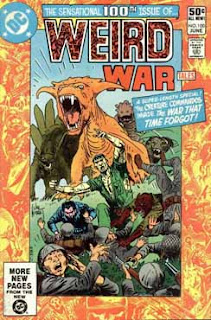
Wednesday Comics: DC, June 1981 (wk 1 pt 2)
Monday, March 7, 2022
A Game I Would Like to Have Seen
Logan's Run may have come out a bit too early for an rpg tie-in, but it seems like the sort of thing FASA would have got a hold of if anybody did.
I think the setting has a lot of rpg potential, particularly as developed in the TV series.
Sunday, March 6, 2022
Weird Revisited: The Life Aquatic
![]() |
| A merman and his landwoman bride. Grand Lludd, 5825. |
In the waters west of Ibernia, ship passengers occasionally glimpse and wonder at light in the depths. These are the lights Undersea, municipality of the mer-folk. Part of the empire of Grand Lludd, the citizens of Undersea have never been Her Preserved Majesty’s most loyal servants. Only the threat of submarine bombardment has stifled open rebellion at times. Still, in these hard years following the Great War, land and sea need each other too much for such squabbles.
The mer-folk are not to be confused with mermaids, despite similarity in names. Those half-fish creatures (and wholly nonhuman, whatever their appearance) are more akin to faerie. Mer-folk look, for the most part, like surface humans except for a slight bluish tint to their skin, eyes a little larger than usual, webbed hands, and a slight tendency to barrel-chestedness--though its common for portrayals of them in art to exaggerate their inhumanness. So little apparent difference for beings naturally inhabiting great depths and pressures hint at the subtle magics that have been used to adapt them to a submarine life. Scientists suggest this points to them being an engineered race, perhaps derived from Meropian stock. Mer-folk find this whole line of speculation dull, and are largely unconcerned with their own origins.
Perhaps its this lack of curiosity, among other traits, that has led to the common Lluddish stereotype of Mer-folk as thickwitted. They're also held to quick-tempered and lascivious (a judgement perhaps derived from their indifferent attitude toward clothing--at least in the seas). Mer-folk don’t drink (at least not in their usual habitat) but their men tend to enjoy licking certain sea slugs for an intoxicant effect, and singing (it can be called that) gurgling, warbling shanties, while their women perform suggestive, water ballet-like dances.
Though they are limited in the areas of metallurgy, chemcal, and alchemical sciences, the mer-folk are not utter primitives. They use magic to shape stone for buildings, and have either used animal husbandry or magic to enhance the abilities of sea creatures for their use. The lantern jellyfish sometimes seen in aquariums are best known example.
On land, mer-folk must wear something like reverse diving suits--pressurized suits filled with water--unless they have access to magic aid. They're able to breath air, but the exertion quickly tires them and it's uncomfortable for more than a half-hour or so. Their skin quickly dries out in air, as well. The use of heavy suits isn't as cumbersome as it might seem as mer-folk are stronger than a surface human of comparable size.
There are some mer-folk enclaves in the New World. The largest of these are in New Lludd, there mer-folk are involved in fishing, and the Southron coast where they engage in sponge harvesting, as well.
Friday, March 4, 2022
Constraints & Creativity
People are free to like what they like, of course, but I don't agree with these complaints for the most part. Every setting or game excludes as many things (or more) as it includes in how it defines itself. Even kitchen sink or gonzo settings have parameters and boundaries. Game systems themselves constrain with their rules.
There is obviously some give and take here. A GM who wants to run a D&D setting with more than the usual restrictions on options should communicate that and probably the reasons for it before hand, but armed with that knowledge, players ought to trying to make up characters that would fit the setting and negotiating with the GM regarding parameters. Honestly, I feel like I've had just as much fun playing a well-defined pregen than making up my own character, at least for short-run games.
I'm hardly the first to note this, but it seems to me constraint can stimulate creativity. It's true on the player side, but I think it's also true on the GM/setting creation side. With an large number of worlds to play with, it should be a trivial matter coming up with interesting planets, but the Star Wars franchise seems to have a tough time showing us anything but the same three or four biomes over and over. And most of those are are one biome: deserts, but perhaps that's a different problem. I don't think Star Wars is the only franchise that lets quantity substitute for quality. It's easy to do.
But If you've got a smaller number of worlds like a solar system, you've got to make every one count, and you might well use each one to it's fullest. Maybe they aren't all single biome planets, but even if they are, you would tend to have them have different sorts of jungle or different sorts of deserts to get the most out of it. All of that is creativity you would never have been forced to exercise if you had a bunch of planets to spare.
Maybe its just me. Try it for yourself, by self-imposing some constraints you wouldn't normal give yourself in worldbuilding or adventure design and see how it turns out.
Wednesday, March 2, 2022
Wednesday Comics: DC, June 1981 (wk 1 pt 1)
Monday, February 28, 2022
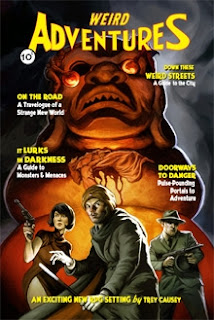
A Decade of Weird Adventures
I realized this past weekend that I had missed Weird Adventures' tenth anniversary on December 15, 2021. We are also not too far away from the twelfth anniversary of my introduction of the City on my blog on April 18, 2010.
Blogging about that setting was where my blog really took off, to the extend that it did. While Strange Stars eventually proved to be the more popular setting, at least in terms of sales, I've always felt like Weird Adventures was the more unique setting. While Bloodshadows had been around since 1994 with a combination of high fantasy and noir, I think Weird Adventures works I bit differently, drawing form not just surface level noir or pulp conceits, but a whole host of early to mid-20th Century pop cultural material. Weird Adventures could sort of do Cast A Deadly Spell, but it's just as much Thimble Theater and Wellman's Silver John stories and American folk- and fakelore--plus whatever period pop cultural ephemera I came across at the moment.
In the past few years, I've been recycling some older posts on my blog, but I've mostly been avoiding Weird Adventures posts because the book exists and an index linked from the blog main page. I think I will start revisiting some of my favorite posts from that series, though, particularly ones with material that didn't make it into the book.
Thursday, February 24, 2022
The Books of Babel
I recently finished reading The Books of Babel tetralogy by Josiah Bancroft. The series was so engaging I plowed through them all, only taking a brief intermission between books two and three to read Watts' Blindsight. The Books of Babel are Steampunkish fantasy, set in the titular Tower, which is something of Big Dumb Object in science fiction parlance.
The series starts with Senlin Ascends where the schoolmaster of a small seaside town and his new bride get separated on a visit to the Tower. I hesitate to say too much regarding the arc of the series for fear of spoiling it, but suffice to say there are multiple ringdoms of almost Vancian cultural eccentricity, Steampunk technology including "cyberware" supplied by a mystery inventor high up in the Tower, air ship pirates, and secrets to uncover aplenty, including the mystery of what the Brick Layer, the head of the Tower's construction, actually intended as its function.
The series has a fair amount bit of humor and the chapter epigraphs from in-world works are often wry, but the Tower is also a rather cruel and violent place at times. Bancroft's narrative doesn't flinch from this or keep the events at an ironic distance. Besides Tom Senlin, the headmaster, there are a number of other viewpoints characters, most of whom are capable women--though there's also a fastidious stag whose brain has been transplanted to a robotic body. But I said I didn't want to give too much away, didn't I?
Anyway, the series is well-worth checking out, and I think would give a lot of inspiration for rpgs in addition to being a fine read.
Wednesday, February 23, 2022
Wednesday Comics: DC, May 1981 (wk 2 pt 2)
The Men of Easy feature by Kanigher and Mandrake "Winter Soldier" (heh) focuses on the Ice Cream Soldier. He likes ice cream so much he'll eat snow. That's about it. Then there's a story by Mandrake which is really more a Weird War Tale: A Roman soldier on the Antonine Wall. Oppressing the Picts, he stumbles into a fairy ring and gets transported to present day. The final story is a completely forgettable Civil War tale with art by Duursema.
Monday, February 21, 2022
Weird Revisited: The Wild Wood
One tragic loss of the Great War was the area of Grand Lludd known as Wild Wood. Covering a hundred acres of farm and woodland, it was the home of various species of anthropomorphic animals. Now much of the land has been despoiled, and most of its inhabitants have been killed or displaced.
These creatures were the product of biothaumaturgy and the eccentric genius of one man, Gaspard Mauro. Mauro gained the support of the crown in his endeavors by promising applications of his techniques in creating servitors to free mankind from hazardous labors.
His work never amounted to more than a curiosity. Still, the Queen herself was quite fond of them, and on the occasion of her eighty-ninth birthday had a group of the animal-folk perform for her. There is one wax-cylinder recording said to exist of their cheerful, high-pitched singing.
Most of the animal-folk appear to have died in bombing during the war. There is evidence that some burrowing species may have survived, and there are worrisome reports that rats, taken to Communalitarianism, may have absconded with some of Mauro's notes, and are now undertaking a program of evolution and revolution among the rodent underclass of several cities.
Sunday, February 20, 2022
Blake's 7
Something we read online last week prompted a brief discussion on Discord regarding the British science fiction series Blake's 7 (1978-1981). The show involves a political dissident (the titular Blake) leading a small group of escaped prisoners turned rebels (the titular 7) against the forces of the totalitarian Terran Federation. I don't know anything much more about the setting or how the plot plays out than that, having only seen the first episode years ago on PBS, but I think the concept has plenty of rpg potential.
There's nothing wrong with the set-up as is with the serial numbers filed off. The comic book series Six From Sirius would be another potential inspiration for this sort of thing--both in plot elements and characters and in 80s sci-fi trappings. I can think of a couple of ways the idea might be tweaked, though.
The first (possibly predictably, since I've done this before) is strip away some of the space opera conventions and have it confined to the solar system with more realistic tech. This becomes a little bit more cyberpunk, I think. It would be darkly dystopian, certainly, but serious or satirical would be possible.
My other though is to retain the galactic scale, but not have the setting be so humanocentric. Borrowing a bit from Farscape, the escaped prisoners might be a motley, mostly alien crew.
Friday, February 18, 2022
Weird Revisited: Rogue Elephant
The Mastodon Colossus, or Hotel Elephantine, was built as a tourist attraction on Lapin Isle in the City’s barony of Rook End. The (admittedly eccentric) architect Jamis Maguffin constructed it through consultation of certain codices of the Ancients--and some magical materials probably dating to Meropis dredged from the City’s harbor. The elephant was twelve stories tall and had stout legs 60 feet in diameter. It had 31 guest rooms, a gallery, tobacconist's shop, and an observation deck shaped like a gigantic howdah.
Most spectacularly, the whole thing was planned to move. Maguffin promised that when all of the thaumaturgic glyphs and enhancements were complete, the elephant would be able to ambulate without any seeming change to the rooms on its interior. These enhancements, unfortunately, would take some time.
Eleven years later, when the thaumaturgical working was (supposedly) nearly complete, the elephant walked away one night with a compliment of guests. Most have turned up dead in various locales all over the world and beyond in the four decades since.
This post first appeared in February of 2011. I did a post on the real elephant-shaped buildings of our world after it. You can also read more about them at your local library. Or, you know, the internet.
Wednesday, February 16, 2022
Wednesday Comics: DC, May 1981 (wk 2 pt 1)
The Aquaman backup by DeMatteis/Heck continues. Here we get the strange history of Aquaman's mother, which I suspect was ignored after this story, from the Poseidon android who has a replica of the mind of Aquaman's father. Atlanna was one of the original survivors of Atlantis. She became immortal thanks to a serum of her creation. After her supposed death following Aquaman's birth, she apparently went crazy. She hates the Atlantis that exiled her, and now wants to kill her own son who is prophesized to be it's savior.
In the Nemesis backup by Burkett and Spiegle, Nemesis escapes from the police officer trying to take him in and continues to try to foil Chesterton's plot. He figures out the kidnappings are chess themed, but things are complicated by Valerie getting into trouble.
Monday, February 14, 2022
How Do You Like Your Sci-Fi?
I posed this question this question as the title of a blogpost the irst time on February 15, 2013. It's a topic that TV Tropes--unsurprisingly--has some thoughts on. This scale is a bit granular and more detailed (and perhaps a bit more judgey). Here's my sort of summary of the basics of both of these:
Hard: So, on one end we've got fairly plausible stuff that mostly extrapolates on current technology. This includes stuff like William Gibson's Sprawl series and the novels of Greg Egan (from the near future mystery Quarantine to the far future Diaspora). A game example is this category would be somethig like GURPS Transhuman Space.
Medium: Getting a little more fantastic, we arrive in the real of a lot of TV shows and computer games. One end of this pretty much only needs you to believe in FTL and artificial gravity but is otherwise pretty hard. The fewer impossible things you're asked to believe (and the better rationalized the ones you are asked to believe in are), the harder it is. Hannu Rajaniemi's Jean Le Flambeur trilogy falls here, on the harder end. The middle of this group adds in something like psionics (Traveller gets in here, and a lot of science fiction novels, like Dune and Hyperion). The softer end throws in a lot of too-human aliens and "pure energy" beings (Babylon 5, most Star Trek).
Soft: Here lies fantasy but with a science fiction veneer and context. Some Star Trek (the animated series, particularly) comes in here, and Farscape. This is also the domain of Star Wars. Simon R. Green's Deathstalker cycle turns up here, too.
Ultra-Soft: Some Star Wars tie-ins in other media come in here, as do things that include magic (or similar fantastic elements} mixed in with an otherwise soft sci-fi universe: This would include superhero sci-fi properties (the Legion of Super-Heroes and Guardians of the Galaxy) and comic book epic sci-fi (what might also be thought of as Heavy Metal sci-fi) like Dreadstar, The Incal, and The Metabarons. It's possible it stops beings science fiction on the mushiest end of this catgory and just becomes "fantasy."
So what consistency of sci-fi is your favorite--particularly in regard to rpgs?
Sunday, February 13, 2022
Weird Revisited: After the Flood
After a weekend of heavy rain and flooding in this neck of the woods, some uses of floods and their aftermaths in games is on my mind. There's what I've got:
The Lost City: Inundated coastal cities might become lost or at least legendary. Ys is a good example. There's typically a mystery here or at least potent magic. It might be a whole area to explore, or just a bit of weirdness in a campaign.
Looting the Depths: Jesse Bullington's The Folly of the World includes an attempted theft in town submerged by the Saint Elizabeth's Flood of 1421 (the 20th worst flood in history). "Moon fishing" is apparently the term for treasure hunting among the ruins of the towns flooded by China's Three Gorges Dam. Looting underwater would present special challenges for adventurers and a different array of monsters than the usual.
Something Strange Beneath the Surface: You already know about aquatic elves and aquatic trolls, but let's got deeper. In Swamp Thing #38, Alan Moore presents an aquatic mutation of vampires in the submerged town of Rosewood, Illinois. Any monster can have an aquatic variant but the key to making them non-mundane is having them by one-offs in unusual circumstances. The 2021 French horror film Deep House likewise has a supernatural horror continuing beneath the waters of a flooded town.