Wednesday, February 15, 2023
Wednesday Comics: DC, May 1982 (week 3)
Monday, February 13, 2023
Weird Revisited: Froglings for 5e
Frox or Bufokin (a bit of a misnomer, as frox resemble frogs more than their warty, dry-skinned cousins) are amphibious humanoids native to the bottomlands and marshes of the country of Yanth. Following rivers, they've ranged beyond their ancestral home to be a common sight in river towns. Their call and response work songs can be heard dockside all over Azurth. Frox work as bargemen or stevedores in civilized areas, and as hunters, farmers, or guides in their villages.
Frox legends say they come from a land across the Boundless Sea, which they left to escape persecution by a terrible and poisonous race of toad-folk, but this claim is considered doubtful by the scholars of Azurth for many reasons--not the least of which being that the Boundless Sea has no other side!
Frox are generally shorter than humans and tend to be thinner of limb, though many develop a potbelly as they age. Their skin colors are generally a dull green or brown, though they range from muted reds to purplish-gray.
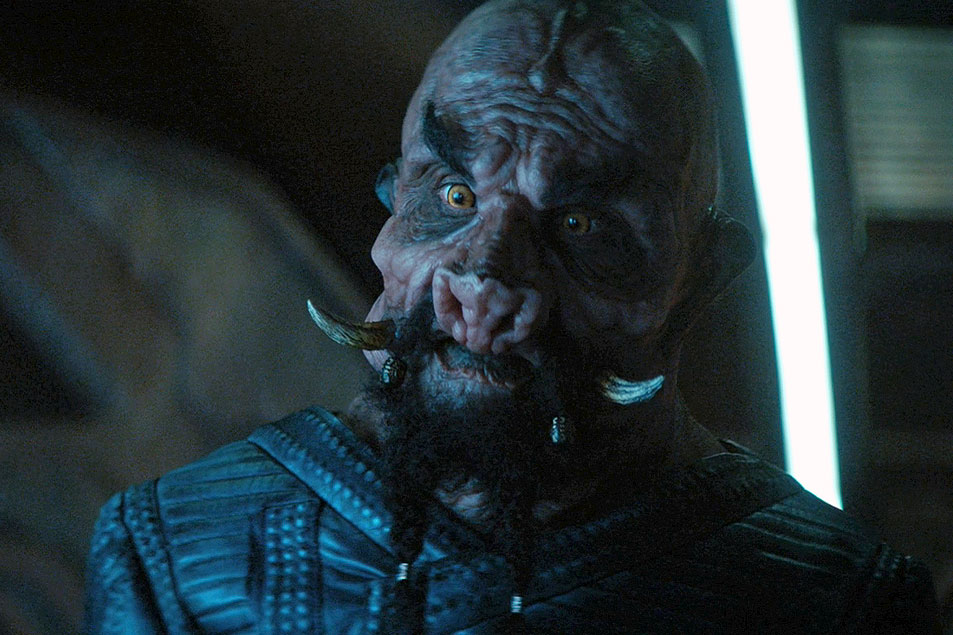
| A wealthy Frox businessman and tribal chieftain visiting the palace |
Frox Traits
Ability Score Increase. Dexterity increased by 2 and another ability score by 1.
Age. Frox live shorter lifespans than humans on average with only a few living beyond their mid-60s. They are mature by their early teens.
Alignment. Frox tend toward good but are have no special affinity for Law and Chaos.
Size. Frox are between 3 and 4 feet tall. Small.
Speed. Base walking speed in 25 feet.
Jumper. Frox can long jump their full Strength score in feet from standing start, and double their Strength in feet with at least 10 feet of movement in a running start. They can high jump a total of 6 feet (rather than the usual 3) + their Strength modifier in a moving high jump and half that for a standing jump. They have an advantage on Dexterity (Acrobatics) checks to land in difficult terrain.
Swimmer. Frox can swim at their full movement rate and rough waters only cost them 1 extra foot for each foot of movement. They use double their Constitution modifier for the purposes of holding their breath.
Resistance to Poisons. Frox have an advantage on saving throws against poison and resistance against poison damage.
Moisture Dependent. Frox require twice as much water as most races. However, submerging most of their body in water for 20 minutes or more reduces their requirement to standard levels.
Languages. Frox can speak and read (limited) Common. They also speak their on croaking, chirping tongue, which has no written form.
[Thanks to Evan Elkins, the creator of the Froglings, the basis for the Frox.]
![]() |
| A frox traditional dwelling |
Friday, February 10, 2023
Weird Revisited: Found in a Shoebox
The most dangerous photo of the lot. If stared at during night, the photo may open a portal to the pictured manor in a strange demi-realm shrouded in mist and populated by people who appeared to come from a gothic horror yarn. Anyone transported to the realm will be there for 24 hours on earth--though the exact time in the demi-realm is variable: anything from one night to a two weeks.
The Succubus
Naughty postcard from roughly 40 years ago. It can be used to summon a succubus once per week if the incantation written on back is read and a few drops of the summoners blood (or other body fluid) is spilled into a circle draw on the floor.
Wednesday, February 8, 2023
Wednesday Comics: DC, May 1982 (week 2)
Monday, February 6, 2023
13th Age
I've had the 13th Age core book for sometime, but after picking up most of the rest of the publications for the game in a recent Bundle of Holding, I decided to give it a try. My online group was willing to give it a try.
For the unfamiliar, 13th Age is sort of an "alternate evolution" of D&D. Debuting in 2013, it sort sort of took D&D 4e and stepped in a rules lighter direction, adding some freeform elements, quite different from the specification of 3e versions of the game. It's roughly equivalent in crunch, I would say, to 5e, but lighter than 5e in some areas.
We spent the first session in character creation. It took perhaps a little longer than 5e because the freeform elements required a little more thought. What are these elements? Well, the biggest is that every character has "One Unique Thing" some (noncombat) thing that sets them apart from perhaps everyone else. Not only does this serve as a character hook, but it allows the player to define something about the world.
Then there are backgrounds. Unlike 5e backgrounds which are essentially packages of skills and accoutrements, 13th Age backgrounds are player defined (and presumably GM negotiated) broad skills. You could do something simple like "Miner," but it could also be something like (one my wife picked) "Gnomish Debutante." Like the One Unique Thing, backgrounds have the effect of fleshing out the world to a degree. The only downside I see to them is that characters might not be as "well-rounded" in the arena of adventure related tasks as their 5e counterparts. Still, that just means that (like older versions of D&D) skills are likely of less importance.
One final element not found in typical D&D is that every character has a relationship to one of the settings Icons, vaguely defined (so the GM can flesh them out more) beings of great power and importance in the setting. Characters can have a positive, conflicted, or negative relationship with one or more Icons. These are meant to be adventure hooks. You roll to see when they might come into play.
Anyway, the group seem to like what they've seen of the system so far and are interested in giving it a go.
Friday, February 3, 2023
The Age of the Wizard Kings
Millennia after the technological civilization of humankind was cast in ruins, a strange, new world had risen from the old. This time was known as the Age of the Wizard Kings as it was dominated by practitioners of magic. While the most of humanity had reverted to primitivism, the smaller, near human folk that are the ancestors of elves, dwarfs, and halflings, dominated the eastern part of the continent through their mastery of magic.
The Wizard Kings at earlier times had been ranked according to power, but by the time of the Orc Incursions that ravaged the land and threatened the stability of their rule, they were more or less equal in power. They held a magical contest to see who would possess a mystic tome of great power. Details have been lost to time, but someone that contest resulted in the ascendance of the Dark Lord, whose ultimate defeat came at a terrible cost. The city-states never recovered and were easy conquests for the human tribes entering the region.
Despite the millennia since it's fall, the influence of the Age of Wizard Kings can be felt in the present day. Many of the spell formulae known by human mages in the present day and many half-buried ruins and subterranean treasure vaults current adventurers seek to plunder date from this period.
Wednesday, February 1, 2023
Wednesday Comics: DC, May 1982 (week 1)
Monday, January 30, 2023
The Rise of the Orc
Orcs first appear in the annals of history in the Age of the Wizard-Kings. Though they had already been mutated from pre-cataclysm humanity, they were at that point less divergent than today. As highly organized military bands, they raided across the mountains and into the lands of the Wizard-Kings. They were greatly feared due to their mastery of some of the lost technology of humankind.
Latter day scholars have been skeptical on this point, but surviving writings from the era make it clear the Orc bands struck rapidly through the use of motorized conveyances. Their depredations further destabilized the fractious, petty kingdoms and hastened the end of the Age. The chaos that followed, however, was damaging to Orc culture as well, and those in the East did not retain much of their technology in the aftermath.
The Orcs see themselves as the defenders and preservers of High Human Culture. They wish to restore a perhaps-mythic paradise called Murka. The fierce war eagle is their symbol for this land and for their own people. The ancestors of the Orcs apparently survived much of the devastation of the collapse of previous human civilization by moving underground, and modern Orcs continue to be at least semi-subterranean. They believe in the necessity of keeping their race "pure," and tend to remain apart from other peoples. They have a reverence for items of technology and often worship ancient machines with grisly sacrifices.
Orc knowledge of ancient technology is generally more advanced peoples. Some Orcish groups in known regions have abandoned the marauding ways of their ancestors, but not their love of technology. They often make a living as tinkers or mountebanks.
There is said to be a still-thriving Orc Empire to the West in possession of powerful and frightening ancient weapons of war.
Wednesday, January 25, 2023
The Gygaxian D&D Implied Setting Recipe
I present this only semi-seriously, and I'll admit to a less than unassailably rigorous methodology--but I think I have identified the key ingredients and steps involved in creating a D&D setting that would have the true old school D&D (as opposed to Old School Rennaissance) vibe. These steps were developed from pondering the various inspirational reading lists supplied by Gygax, including some forum responses regarding the most important works there in, and comparing it to the implied setting of the manuals and the explicit setting of Greyhawk.
Here's what I came up with:
1. Take Middle-Earth and excise the human nations/cultures, gods and history.
2. Replace with the relevant material from Howard's Hyborian Age (making sure to keep the ethnography and mass migration) and add additional nations/cultures and deities as needed from the Elric Saga and the fantasies of de Camp.
3. Work in a cosmic struggle between Law and Chaos, derived from Anderson with seasoning from Moorcock
4. Place at least one Lankhmar stand-in urban center.
5. Sprinkle in lost worlds from Burroughs and some extra dimensions from Theosophy and de Camp.
5. Strain out any pulp magic in favor of a "logical" and pedantic magical system flavored with Vance, but with a foundation in de Camp/Pratt.
6. Downplay any doomed or destined, great heroes in favor of a cast of scoundrels rounded up in Vance's Dying Earth and Leiber's Lankhmar.
7. Pull monsters from anywhere and everywhere, including science fiction (particularly post-apocalyptic).
8. Emphasize underground environments with a hint of St. Claire and Leiber's Quarmall.
Wednesday Comics: DC, April 1982 (week 4)
Monday, January 23, 2023
Back to Broken Compass
One of my two gaming groups picked back up last night after the holiday hiatus. We got back into the "Serpent Throne" adventure for the pulp version of Broken Compass.
I've noticed that CMON has made the pirate supplement, Jolly Roger, and Voyages Extraordinaires, the supplement for Jules Vernes type adventures, available on drivethru. They both seem pretty cool, but there are other things from that last Kickstarter I hope they get out soon.
Friday, January 20, 2023
Weird Revisited: The Conquered Setting
Wednesday, January 18, 2023
Wednesday Comics: DC, April 1982 (week 3)
In the backup by Levitz and Giffen, Princess Projectra is crowned Queen of Orando after her father's death, but her cousin challenges and defeats both her and Karate Kid in a trial by combat for the crown.