Wednesday, December 23, 2020

Wild Wild West Wednesday: The Night of the Whirring Death

Let this re-posting of a Christmas-ish episode of Wild Wild West serve is a reminder that Jim and I are reviewing the series here on his blog...


"The Night of the Whirring Death"
 
Written by Jackson Gillis
Directed by Mark Rydell
Synopsis (from IMDB): Jim and Artie are collect money from millionaires buying bonds to save California from bankruptcy. The problem is, Dr. Loveless is back and blowing up the would-be benefactors with booby-trapped toys to steal the money.

Trey: This is the closest WWW came to a Christmas episode. It isn't stated in the episode to be Christmas, but the winter weather, focus on toys, and other story elements give they vibe. It aired, however, in February of 1966.

Jim: It starts off with a nice tip of the hat to Charles Dickens’ A Christmas Carol with Jeremiah Ratch taking the place of  Scrooge. Ratch is played by Norman Fell, aka Mr. Roper from Three’s Company. Fell’s comedy chops come in handy as he hams it up with the Ratch character for the short time he’s on the screen.

Trey: This is Dr. Loveless' third appearance and the first not written by his creator. It sticks pretty close to the established Loveless schtick though: he's still trying to carve his own kingdom out of part of California. Voltaire (Richard Kiel) and Antionette (Phoebe Dorin) are back, as well.

Jim: I believe this is the one and only time Loveless is ever shown smoking. It’s mostly for comical effect, admittedly, after he's revealed as the “child” who gifted Ratch toy soldiers.

Trey: Voltaire speaks for the first time, too. It's note as being a change within the episode. One Loveless related conundrum: Why does the brilliant doctor continue to employ lovely female assistants in his plans, who he knows by now are only going to fall for West's charms?


Jim: He tries to maneuver Priscilla away from it, but to no avail! She is the most wide-eyed innocent of the group, so far.

Trey: Unbelievably naïve is the better descriptor! I wonder if her toy maker grandfather raised her with no contact with the outside world?

Jim: A funny bit is the look of cynical disbelief on lovely Antionette’s face when Priscilla is convinced by Loveless that the exploding toy train is a perfectly fine toy.

Just putting this out there: with the naivete Priscilla displays, I think a nice plot twist for the episode would’ve been to have her be revealed as a human sized animatronic created by Loveless. 

Trey: I could buy that.

Jim: In general, I think the level of technology in this episode seems a bit advanced. We see electric trains and phonographs.

Trey: The phonograph was an anachronism noted in Loveless's first appearance. The electric train is similarly just a bit ahead, having been invented in the 1890s. Incidentally, this episode actually gives us an onscreen place and time: "San Francisco, 1874."

Jim: One of the unintentionally funny bits to me: After West is ground zero at the explosion in Ratch’s shop, Gordon proclaims that he's fine and just needs some rest. Supporting him in this dubious claim is a city cop who says, “He’s right lady. Working this beat, I’ve seen enough to know he’ll be fine.” Just how violent is this neighborhood?

Trey: Thinks are hard in California in this alternate 1874, apparently. I mean, the governor's plan here is explicitly laundering money for rich people with shady, possibly criminal, business practices to keep his state solvent. 

Jim: Vote Loveless! How could it be worse?

Monday, December 21, 2020

Reconquest of the Surface


The war, known now to the survivors as The Fury, was devastating. As many as could be saved were moved into underground habitations built for this very eventuality. Not everyone was lucky enough to have a place in the shelters, and when the leaded doors were closed and sealed, many people were left to fight for survival in the gloom, as the radioactive and mutagenic haze played strange tricks with the light of the sun and moon, and death burrowed into their bones.

The species survived, though, and in those underground redoubts, so did civilization. The old nations were forgotten with time and new ones formed, as fresh tunnels linked farflung bunkers. They only need to wait and endure. Eventually, the scientists said things might be safe, and so scouts were sent outside.

They were not prepared for what they found. The natural world, as they had hoped, had healed itself. There was no trace of the world that had been or the war that destroyed it. Things were lush and green--though that didn't mean all the horror or strangeness it was gone.

There were people on this new Earth, apparently the deformed descendants of those who had been left outside. Dwarfish ones one had perhaps come from makeshift bunkers not sufficiently sealed as they too spent much time underground. People of the forest, grotesquely thin and large eared, and then the most numerous people who lived in primitive cities. All of them were hideous. There was sometime neotenic about them in a way that made the skin crawl: their teeth were so small, their foreheads flat, their jaws receding.

Councils were convened to consider this information. The technological know-how of the people was superior to their mutated cousins, but they were limited in their access to resources and many of their machines had broken down. They were, ironically, fewer in number than those who had survived the terrors of fallout. 

The decision was made not to wage an all out war for the surface, but instead to look for out of the way places to recover resources. They would approach the mutants, when necessary using similar technology--they could not afford to have any more advanced devices fall into the primitives' hands. They could perhaps surreptitiously influence them, maybe create allies to prepare for their return. Some might have to die, of course, but perhaps the more could be shepherded toward civilization.

It would be a long project, but humanity was up to it. For now, they would have to embrace the name "orc" given to them by the mutants and play the expected role.

Sunday, December 20, 2020

Christmas Special Reruns


Years ago, I managed to do three "Christmas Specials" in my two Weird Adventures campaigns (though I only did 2 write-ups): "Twas the Fight Before Yule," and it's sequel, and "Another Weird Yule." In 2016, there was a holiday related cameo in my Land of Azurth game.

I at one time considered doing the reskin of Slumbering Ursine Dunes involving the Weird Adventures version of the Tunguska Event, the mysterious Siberian cauldrons, a captive Father Yule, and talking bears. I never did it, but I still think it would be great.

Thursday, December 17, 2020

Lumberlands


Erik Jensen's Zinequest entry Lumberlands delivered not too long ago. It's not yet available in physical copy, but that's coming.

Lumberlands is a region of Erik's Wampus Country setting, for which we are still, lo these many years later, awaiting some sort of overview setting publication. I had the privilege of playing a number of sessions in Erik's Wampus Country campaign back in the days of Google+, and so I was eager for Lumberlands.

Can it be you've never heard of Wampus Country? Well, allow me to sketch it in brief: It's an old school D&D setting that borrows its visual trappings from the American history, folklore, and fakelore to a large degree. Its fighters might be more Mike Fink or Davy Crockett (subject of the Disney series, not the real-life Congressman), than Aragorn or Conan. Still, it would be a mistake to think of it as merely "Frontier Fantasy." It has that as it's base, certainly, but Wampus Country exploits the fruitful incoherence that is D&D at its core and weaves in all sorts of sources, so that many sorts of character types and potential adventures are possible.

But anyway: Lumberlands! Lumberlands narrows the Wampus vibe geographically to a fantasy take on the Pacific Northwest and Paul Bunyan-y concerns, while in no way being bound to the imaginative parameters of that inspiration. It details the differences between the version of the classes in the setting (i.e. the traditional ones with a lumber- prefix and flannel-centric illustration). It sketches the human habitation of Squeemish, but also the squirrel city of Baudekin and the dimensionally unstable region of Portal-Land. 


There are monsters with pun names (clever ones!) and a selection of humorously sketched hench-folk available for hire. And Sasquatches, which are actually arachnoid aliens. 

As you may have guessed Lumberlands does not take itself to seriously, so if grim is your only mode of roleplaying well it isn't for you. But the rest of you, I urge you to check it out.

Wednesday, December 16, 2020

Wednesday Comics: DC Through the 80s


Somehow, I missed the original solicitation of this one, though I did see what is presumably the follow-up: DC Through the 80s: The Experiments. It was tempting, but ultimately I thought it was too scattershot to warrant a purchase.

DC Through the 80s: The End of Eras, despite it's to my ear awkward title, seems more like one for the shelf. Many of the good comics reprinted here I already own, but there are others I have never read and there's some interesting supplemental material, including (supposedly) Moore's proposal for Twilight of the Super-Heroes.

What's in here that I would recommend? Well, there's Moore's and Swan's "Whatever Happened to the Man of Tomorrow?" Of course, you've probably already read that one. There's also story I recall fondly from my childhood: A crossover of the Earth-Two and Earth-One Batmen by Mike Barr and David Gibbons from Brave and the Bold #200--the final issue of that title. There's a less good, but still fun crossover between Lex Luthors of those same Earths from DC Comics Presents Annual #1 by Wolfman and Buckler.

Pulling from some non-supers titles of the era, we have Blackhawk #258 by Evanier and Spiegle where the Nazis destroy Blackhawk Island with an atom bomb. This whole run is probably under-appreciated. 

There are a number of DC horror titles and the sci-fi anthology Timewarp represented. And there's war comics, including Weird War Tales #93--the first appearance of the Creature Commandos. 

And there's a random issue of Warlord

Monday, December 14, 2020

The Land of Azurth Year in Review


While we have one more session of our Land of Azurth campaign before the end of the year, it's a good time to look back at what the "Masters of Mayhem" (as the party calls themselves) got up to in year six, game sessions 53-69.

The Vault Job
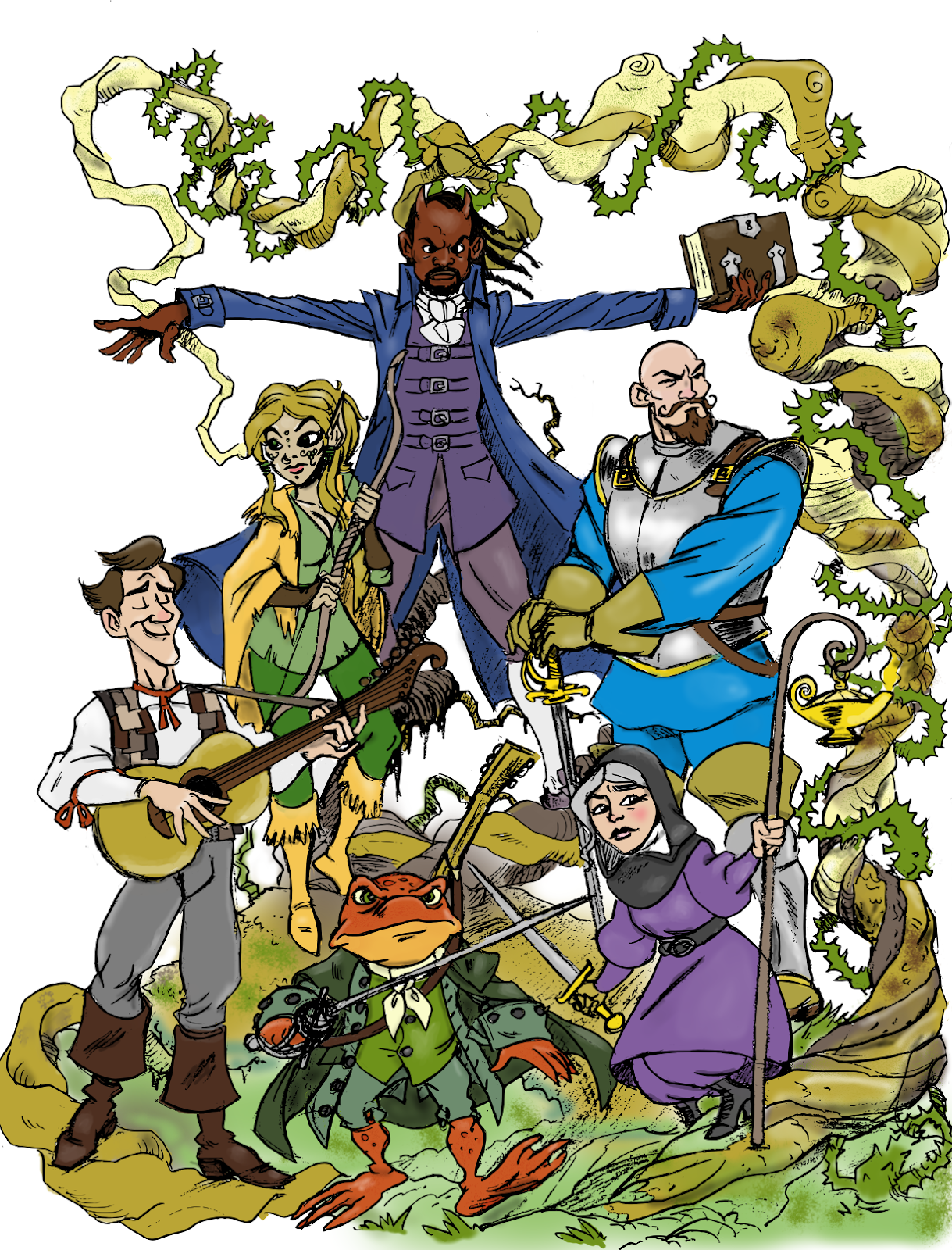
The party returned from a trip to a dark future to find the Clockwork Princess of Yanth Country in seclusion, and Drumpf the new, authoritarian mayor of Rivertown. The lure of gold convinces the party to help the former mayor Gladhand liberate some of this gold, currently being held in the vault of Sly Took, member of the Raccoon Thieves Guild and banker to the underworld. The party hatched an elaborate scheme involved a magical armoire and succeed in getting Gladhand's gold.

With the heat on, and wanting to talk with the Queen of Virid about events in the future anyway, the party headed out on the road.

Servants of Shadow
Near the northern border Yanth Country, they party stopped to help a village of cervid centaur folk who are being menaced by a bickering couple of Umbral drakes who emerged from a shadowy vortex within an ancient ritual circle. The party kills the drakes, but it turns out they are only the first incursion of agents of Umbra, the Shadow Moon. A group of Gloom Elves are inhabiting a half-dilapidated tower.

Uncharacteristically, the party winds up reaching a compromise with the elves. They hold a cryptic conversation with a vaguely familiar shadow man who steps through a door opened by the elves.

Shkizz
Further down the road, they decide to spend the night in the town of Shkizz. They discover the townsfolk are priggish and uptight in the day, but wild libertines at night. The discover a cult worshipping a pig demon, but it turns out he is only taking advantage of the situation, not its cause. He blames it on the High Priest of the Church of the Dark Flower in the neighboring Duchy of Dhoon.


Slekt Zaad
The party finds Dhoon suffering under a series of nonsensical decrees of from the Duke, who no one has seen in some time. The party confronts Zaad who reveals himself as some sort of plant being. He also reveals he's allied with the captain of the Ducal guard and they have the Duke ensorcelled. After busting out of jail, the party makes there way to an ancient fane hidden by kudzu, where discover Zaad's magical botanical laboratories--and they recover the gem that holds Zaad's soul. With that gem, they defeat him and lift the curse on the Duke.

The Demon Barber of the Sapphire City
Finally, the party arrives in the Sapphire City and become intrigued by a series of disappearances and mysterious, magical tonsorial makeovers. It turns out to involve dopplegangers of magic hair and the machinations of a hag and her adoring humanoid tribe. 

The party is reunited with their old comrade Calico Jack who was being held captive beneath the barber shop.

A Famine in Ffalgo
As word of their deed spreads, two teens from the village of Ffalgo on the Sang border seek out the party to request their help in journeying to an ancient castle in Sang, said the magical produce an endless supply of chicken...

Thursday, December 10, 2020

The Metaphysics of D&D


"The wearer of the amulet is filled with Chaotic Evil, which is how I grew up so…"
    - Hunson Abedeer, Adventure Time!

In L. Sprague de Camp's 1942 novella The Undesired Princess the protagonist is transported to a world that follows Aristotlean logic, where everything is either one color or another with no mixing and shapes, besides the animals are all simple: The princess has hair that is primary color red; tree leaves are regular polgons of blue or yellow.

D&D as written often describes a world just as foreign as that. Even ignoring things that you could argue are merely abstractions for the sake of the game (like movement), you still have things like alignment (and in some editions alignment language), leveling, people with classes vs. nonclassed NPCs, clerical healing and the like.

I've read things in the past that posited a world where D&Disms got rationalized a bit (I've maybe written one), but discussion yesterday with a reference to the perennial "baby orc" argument made we think it would be interesting to throw rationalization somewhat out the window and play in a setting where the world just sort of runs on D&D (meta)physics.

We're talking about a world where some people start to develop superhuman resistance to injury and various abilities--and these keep increasing so long as they acquire treasure from underground hordes. Where there's some sort of metaphysical orientation to the universe that leads people to automatically acquire a language recognized by every member of the club when they join up. A world where sentients with lifetimes much longer that humans just can never learn to be better than humans in arms or magic. Stuff like that.

"But no!" You'll protest. "That would be really silly!" 

Sure, but isn't that often the case with D&D?

See?

And this would actually elevate the silliness by making it a thought experiment.

All kidding aside, it perhaps wouldn't be the stuff of a long campaign, but I don't think the implications of that sort of thing would be interesting to think about.

Quest for Chicken


This past Sunday, our Land of Azurth 5e game continued with the party stopped in their preparations to leave Sapphire City on their way to Virid by a request for aid from two youths: Tagg and Dynda. These kids are from the village of Ffalgo near the Sang border. They've been suffering form a famine that blighted their crop and sickened their animals placed on them by a wandering warlock. 

They have a desperate plan to seek out a castle close by in Sang where there is supposed to be a never-ending supply of meat, specifically chicken, waiting for someone to claim it. Sang is dangerous and the elders of Ffalgo are cowardly, so they won't go, but these teens hope heroes will try. The party agrees.

The party is the guest of the village overnight, then the teens lead them to the border where they can take the black road made of some mysterious, durable material to the castle. 

On the way, they are attacked by small, reptilian creatures operating a smoke belching siege machine of some sort. The party's attacks blow the machine up, greatly disappointing Waylon the Frogling who had hoped to claim it on their own. 

When they arrive at the castle, they find it isn't a castle at all but some sort of fenced complex. A sign names it the "Gander Foods - Chicken Plant." Their first attempt to enter leads to Shade getting an electric shock, but the party is persistent.

TO BE CONTINUED

Wednesday, December 9, 2020

Wednesday Comics: 2020 Holiday Comic Gift Guide

 Still looking for something for that comic lover in your life or maybe anticipating having gift cards to spend on yourself after the holidays? Here are some collections I would recommend.

Deadman Omnibus
Deadman has always been one of those deep-bench DC characters I have been fond of. Truthly, also more for the artists than the writing with the likes of Neal Adams, Jose Luis Garcia-Lopez, and Kelly Jones depicting him at various times. I already have the Neal Adams Deadman collection, but looks like I'll be getting that material again plus some never before collected material.

I talked about this post-apocalyptic sci-fi series written by Simon Roy back when it was coming up in monthly issues and was called The Protector

This brutal, revisionist take on the Antediluvian parts of Genesis written by Jason Aaron is now on its second volume, but what better way to get ready for that collection scheduled for release in February with this version of volume where Cain meets Noah.

It's surprising it took so long to get a take on the Hulk that plays like a horror story, but that's what the Immortal Hulk does. It's the sort of a "new take" on the character and his mythology that it seems like was more common in the 90s than today. 


Sunday, December 6, 2020

Star Trek Endeavour: The Evictors


Episode 3:
"THE EVICTORS"
Player Characters: 
The Crew of the USS Endeavour, NCC-1895, Constitution Class Starship (refit):
Andrea as Lt. Ona Greer, Chief Engineer Officer 
Bob as Capt. Robert Locke
Gina as Cmdr. Isabella Hale, Helm Chief
Eric As Lt.Cmdr. Tavek, Science Officer
Jason as Lt. Francisco Otomo, Chief Security Officer
Tug as Dr. Azala Vex, Trill Chief Medical Officer

Synposis: Stardate 5927.1, a festival on the planet Nraka celebrating its 10,000 year of civilization is disrupted by the arrival of gigantic starship carrying a group called the Sanoora who claim to have left Nraka to escape a cataclysm--and now demand the current inhabitants vacate their world!

Commentary: This adventure was based on issue 41 of the Gold Key Star Trek series from November of 1976. In that story, the Sanoora wind up attacking the Enterprise and so the starship helps the Nrakans drive off the would be invaders. Spock only discovers their is some truth to their claim in the coda.

The Endeavour crew handled things in a bit more genuine Star Trekian fashion. They discovered the truth that the Sanoora were indeed from the Nraka, and the Nrakans were descended from the people they left behind when leaving the planet. In a bit of diplomacy, they convinced both sides to stand down, and brought them to the table to negotiate a mutually agreeable solution. The Federation took over from there and sent in a team of real diplomats.

Weird Revisited: The Galactic Great Wheel


So here's the pitch: Sometime in the future, an early spacefaring humanity encounters a gate and gains access to a system of FTL via hyperspace (or the astralspace) and gets its introduction to an ancient, galactic civilization with arcane rules and customs a bit like Brin's Uplift universe. At the "center" of the gates is Hub, a place with a gigantic neutral territory station--like Babylon 5 on a grander scale. Hub connects to all the various worlds. Here's a short sampling:

Archeron: A war world, possibly one where a decadent civilization has kidnapped warriors form different times and worlds to battles for their entertainment.


Baator: The world of beings who (like the Overlords in Childhood's End) look suspiciously like devils from Earth belief, and indeed act very much like them, destabilizing worlds with Faustian bargains somewhat like in Swanwick's Jack Faust.

Beastworld: A planet where many animal species share a group intelligence.

Carceri: An environmentally hostile ancient prison planet.

Limbo: A world in an area of reality warping "broken space" where hyperspace spills in leading to a graveyard of ships.

Mechanus: Robotic beings out to bring order to the galaxy via assimilation. A somewhat (maybe) more reasonable Borg.

Pandemonium: A world only inhabitable in subterranean caverns, but even those are swept by winds that generate infrasound that can drive humanoids insane like the titular Winds of Gath.

Thursday, December 3, 2020

Werewolf Trooper!


Art by Jason Sholtis

The werewolves were supreme in the 32nd century. Only the destruction of the moon final broke their reign.

Monday, November 30, 2020

Star Trek Ranger: Prime Time


Player Characters: The Crew of the USS Ranger, Federation scout ship:
Aaron as Lt.(jg.) Cayson Randolph
Andrea as Capt. Ada Greer
Dennis, as Lt. Osvaldo Marquez, Medical Officer
Paul as Cmdr. D.K. Mohan, Chief Helmsman

Synposis: Ranger is on a cultural exchange mission to Viden, an advanced world who has given up space travel for television. When the crew intervenes in the apprehension of a sitcom who tries to escape his contract, they find themselves the unwilling subjects of a reality show.

Commentary: This adventure was based on IDW's Star Trek: Year Four #4 written by David Tischman. It's a humorous story in the comic in the manner of the TOS episode "A Piece of the Action," though its plot bears some resemblance to "Bread and Circuses" in it's satire of the television industry. The player's certainly took to it in the way it was intended.

Sunday, November 29, 2020

The Three Planeteers


In my short Thanksgiving travels, I managed to complete the audiobook of Edmond Hamilton's The Three Planeteers, originally published in the January 1940 issue of Startling Stories. Other than providing the inspiration for the name, Dumas' novel has little bearing on Hamilton's work.

In a future (Sometime in the 28th Century, I believe. An exact date isn't given.) where humanity has settled all the worlds in the solar system and gradually adapted to them. The fascist dictatorship of Haskell Trask has spread from Saturn and its moons, to all the outer planets, forming the League of Cold Worlds, which now menaces the Alliance of the inner worlds.

The titular trio are the most famous outlaws in the solar system: John Thorne of Earth, Sual Av of Venus, and Gunner Welk of Mercury. It turns out they aren't really outlaws at all, but special agents for the Alliance, pretending to be criminals so the Alliance has plausible deniability regarding their actions against the League. 

With war looming, the only hope of the Alliance to defeat the massive League war fleet is an experimental new weapon which requires the ultra-rare substance radite to work. Good news is there sufficient radite on the trans-Plutonian world of Erebus. Bad news is no one has ever returned from Erebus alive. Well, no one except, it's rumored, a former renegade turned space pirate. Said pirate is now dead, but his daughter reigns as pirate queen in the Asteroid Belt.

Besides the classic space war plotline, Hamilton gives a lot of space opera color: "joy-vibration" addicts, hunters in the fungal forests of Saturn, and the deadly secret of Erebus. It could be easily shorn of some it's old-fashionedness and moved outside of the solar system. Pieces would be easy to drop into Star Wars or any other space opera game.

Friday, November 27, 2020

Go to Very Distant Lands

Art by Steve Ellis

 Adventure Time ended its original run in 2018, but there's a now series of single episode stories on HBOMax. Watching those reminded me how a lot of rpgers were excited about Adventure Time, at least in its early seasons. It's sort of gonzo, post-apocalyptic setting seemed very much cut from the same cloth as a lot of rpg worldbuilding.

No official AT rpg has ever appeared in English, and in the end the show is a kid's cartoon, perhaps more character driven, than exploration based, but I think it would be pretty easy to derive inspiration from the form of AT's Land of Ooo, as opposed to exact content. In other words, if you wanted a D&D campaign for adults to do D&D stuff that was just in some ways reminiscent of Ooo, this is how I would go about it. (If this thread gets comments someone will no doubt mention the Far Away Lands rpg. Let me preempt that by saying that it has slightly different goals. It's more doing an AT but not AT rpg. I'm thinking of "if you want D&D to have more of a resemblance to AT" without going full cartoon.)

So this is what I think:
  • Make the setting more expressly post-apocalyptic. Not in the usual Tolkienian way that D&D usually is, but in the Gamma World way.
  • Avoid the standard versions of standard monsters. You can use names like "dragon" if you want, but avoid the standard fantasy dragons of D&D. Ok, maybe goblins or giants can stay, but no orcs. My suggestion: borrow a lot of monsters and races from Gamma World, and lean heavy on the AD&D Fiend Folio derived monsters.
  • Elementals are important, but maybe not the standard Greek ones. They seem to be part of a fundamental magic structure of the universe, but Fire, Water, yada yada may not be where it's at. Luckily, D&D gives us para- and quasi- elementals that are weirder.
  • Don't be afraid of the player's getting ahold of more advanced tech, but not weapons so much. Let them freely pick up a bit of the 20th or 21st Century here and there, but don't make weapons or combat related. Let them find record players (or ipods), or gameboys and the like.
  • Mutagens and weirdness. While AT doesn't dwell on it, it has decree of weirdness and even body horror that seems drawn from the most fevered of post-apocalyptic or atomic war fiction. The zones of Roadside Picnic have more in common with it that you might think.
  • Negotiation is always an option. Very few creatures should be attack on sight sorts. Most of them have got the same sort of troubles and aspirations as the adventures, just a different point of view.
  • Don't be afraid of humor. The first edition of Gamma World embraced the silliness of its premise and with something like this, you should too.

Wednesday, November 25, 2020

Wild Wild West Revisited Wednesday


Instead of watching some parade on Thanksgiving, you can sit back and read the installments you've missed of "Revisiting the Wild Wild West" a rewatch and commentary on selected episodes by Jim "Flashback Universe" Shelley and myself.

Monday, November 23, 2020

Weird Revisited: Dead Stars & Outer Monstrosities

 The release of the pdf of the William Hope Hodgson-inspired rpg Grey Seas Are Dreaming of My Death last week, brought to mind this post from last year...

Art from the Oldstyle Tales Press edition
As we understand the word," said the old Doctor. "Though, mind you, there may be a third factor. But, in my heart, I believe that it is a matter of chemistry; Conditions and a suitable medium; but given the Conditions, the Brute is so almighty that it will seize upon anything through which to manifest itself. It is a Force generated by Conditions; but nevertheless this does not bring us one iota nearer to its explanation, any more than to the explanation of Electricity or Fire. They are, all three, of the Outer Forces—Monsters of the Void.... 
- William Hope Hodgson, "The Derelict"

Spelljammer has never really felt like it was about exploration to me. There's nothing wrong with that, but plenty of science fiction literature paints space as a place for confronting the unknown. This is really a perfect fit for Spelljammer where its pre-modern, "magical" spacecraft put the stars within reach but not the science to understand any of it. Not that there is necessarily science as we know it to understand, in any case.

I think I would look to the horror/adventure stories of William Hope Hodgson, specifically his nautical yarns like The Boats of the Glen Carrig, "The Voice in the Night," "A Tropical Horror," and "Demons of the Sea." A little pseudo-science borrowed from his Carnacki stories could only help.

The characters are competent space-hands, perhaps mildly colorful rogues like Howard's Wild Bill Clanton or just working stiffs like the crew of the Nostromo in Alien, not bold explorers or science fantasy swashbucklers. Their jobs involving them going through places that are not (usually) inhabited by hostile species of space orcs or the like, but are instead fundamentally almost wild, always strange. Weird danger can rear it's head at any time, and your vessel is just another ship that disappeared in the Void.

Weird phenomena should be encountered as frequently as monsters, I think. Monsters, when they do show up should be unfamiliar, and probably not seen enough to become mundane.

Beyond the stories of Hodgson and Alien, other potential sources of inspiration could be the comic series Outer Darkness, the science fiction stories of Clark Ashton Smith, Poe's Narrative of Arthur Gordon Pym, and of course, Moby Dick

Thursday, November 19, 2020

Some Thoughts on Science Fiction Settings


Thinking about science fiction settings in rpgs (and in film and television which I think is the biggest influence on rpg sci-fi settings) I think that two important factors are scale and frame. Scale is the size of the setting, not necessarily in absolute terms (though maybe), in narrative terms. Frame is a descriptor or genre of the typical types of stories the setting supports. The two factors are not independent or exclusive.

Here are the frames I have thought of with a media representative. There are likely more that slipped my mind:
  • Crime/Hard-boiled Mystery (Outland) - Hard people doing hard things...in space
  • Exploration, Pulp (John Carter) - A stranger meets a strange land or lands
  • Exploration, Mystery/Horror (Alien) - we've found something anomalous and now it might kill us.
  • Exploration, Realistic  - (can't think of film here) - Alien planets are mostly inhospitable, talking to other species is hard!
  • Exotic Ports of Call (Star Trek) - every week another world, another adventure
  • Outpost (Babylon 5) - Everybody comes to Rick's
  • Pioneers (Earth 2) - A little bit of exploration, but mostly we're putting down roots
  • World-trotting (Star Wars) - Constant motion; as many exotic backdrops as possible
  • Galaxy Wrecking (Guardians of the Galaxy) - the universe is vast and wild
I am probably missing some very realistic genres or some "ten minutes into the future stuff"/mild cyberpunk stuff, but I'm thinking mainly here of science fiction settings that include space travel. Some of the categories are also broader than others, too. 

Why isn't Star Trek (for instance) Exploration, Pulp? Despite it's mission statement, the Enterprise mostly seems to go to places people have gone before. They do very little first contact. Their activities harken back to pulp stories about places that are known, but perhaps little understood. Exploration, Pulp in my formulation is really the descendant of the Lost World novel. 

Here are the Scales in order of increasing size:
  • Ship/Station
  • Planet/Megastructure
  • Orbital System (this could be either a group of moons or artificial satellites)
  • Solar System
  • Near/Few Star Systems
  • Several Star Systems
  • Many Star Systems/Galaxy
  • Galaxies+
There is sometimes the issue of "visible scale." A setting may technically have a large scale than what the characters typically interact with. In general, I think the commonly visible scale is most important for fit with frames.

The following frames seem to go best with smaller scales: Crime/Hard-boiled Mystery, Exploration Pulp, Exploration Mystery/Horror, Exploration Realistic, Outpost, and Pioneers.

These frames seem to me to go best with large scales: Exotic Ports of Call, World-trotting, and Galaxy Wrecking.

Wednesday, November 18, 2020

Wednesday Comics: Grant Morrison's Green Lantern

I don't think I've mentioned Grant Morrison's now two year-old and still going run on Green Lantern on this blog yet, so it's about time I did. For the short verison, if you aren't a fan of Morrison or particularly his "mad idea" neo-Silver Age approach to DC characters he has taken at least since All-Star Superman and possibly since JLA, then you probably won't like his run on Green Lantern.

If you do like some of those things....well, you might like it. 

I think for most people Hal Jordan Green Lantern might be a bit of a hard sell. I'm sure there are folks out their that love him (Geoff Johns writes for them, apparently), but I don't know anyone that views him as their favorite. Morrison's take gives him some characterization that he hasn't had before, but I'd hesitate to call it depth. He is stalwart, and cocky, and mostly unafraid. He is also not terrible success at much other than being good at facing down danger and being a hero.

That sort of character stuff mostly takes a back seat to gonzo sci-fi superheroics. Morrison's view of DC galactic and multi-dimensional society is incoherent in the sense that it's hard to discern much when it's coming at you out of a firehose. It's perhaps a bit like Guardians of the Galaxy, perhaps, in a "just go with it" sort of way, but it's also very DC Silver Age filtered through modern sensibilities. It's grounded with the often very police procedural approach taken to the Green Lanterns' job and the tribulations they face. Barely surviving an onslaught from an antimatter universe is followed by a day in court, where the perps play on the judge's sympathies. It even touches on police brutality early in the run, but wisely that's a bit a misdirection. The bubble Morrison is building would probably pop in the face of too much realism.

While the series doesn't lack for action, cleverness and problem solving are often the solution to the stories' central dilemmas, in Silver Age fashion. Liam Sharp's art certainly supports the action and the sometimes trippiness of the setting, but I occasionally sort of wish for someone a bit cleaner-lined to make some scenes a bit clearer and as a counterpoint to Morrison's flights of fancy rather than a henchman. José Luis García-López would have been great for this.

Anyway, it's not my favorite of Morrison's mainstream DC works, but it keeps me coming back. I'm also hoping (like with his Action Comics run) that it has some surprises at the end that make what came before seem even better. We'll see.