Monday, March 24, 2025

[Greyhawk] South Province


Under the enlightened rule of the Herzogin Eliamund, South Province could reasonably boast to being the most cultured and genteel realm of the Aerdi. The first Aerdian university was founded with her encouragement and patronage. The poets and troubadours who were welcome at her court composed ballads of chivalry, romance, and courtly love that then spread throughout the Kingdom. Perhaps owing to a culture dating back to the realm of Flan queen Ehlissa, women enjoyed a greater role in South Kingdom than in the more patriarchal north.

In the North, legends painted Ehlissa as a wicked enchantress, cruel to her subjects. The Southron troubadours, however, sang of her as a wise and benevolent, an interpretation encouraged by Eliamund.

This bright age did not last. The Turmoil Between Crowns saw Eliamund forced from the throne. She lived out her remaining days in an abbey. 

The South Province of 576 CY was not the land it once was. An ill-favored cousin of the Overking, Faastal, sat upon the ducal chair, a man incompetent as he was arrogant. He had been given a task that would have challenged someone of greater talents: to put down rebellion in the South and return the cities of the Iron League to royal control. Faastal crushed the people with taxes to fund his military blunders and dealt over-harshly with any dissent. His efforts only served to stoke the fires of rebellion he had been sent to quell.

For the rebel bands hiding in the forests and the towns barricaded against the Herzog's men, Eliamund became a symbol of their struggle and was given devotion like a saint or hero-god. 

Friday, March 21, 2025

Greyhawk So Far


I've got more posts to come, but I figured it was a good time to put all the posts I've written so far together in one place:

The project idea (though it's perhaps become a bit less Medieval over time than I initially intended. It's still a large part, but not the sole focus).

The Bone March

The Horned Society

The Iron League

Ket

The Holy See of Medegia

The Pale

Rel Astra

The Duchy of Tenh

The Aerdian Church of Law

And some real-world images for terrain inspiration.

Wednesday, March 19, 2025

Wednesday Comics: DC, June 1984 (week 3)

Join me as I read DC Comics' output from January 1980 (cover date) to Crisis! This week, I'm looking at comics that were published on March 22, 1984.


Warlord #82: I discussed the main story here. In the Barren Earth backup by Cohn and Randall, Jinal and her companions rely on the city that serves as D'roz's embassy, and everyone gets to do a bit of relaxing. Jin and Renna visit a bathhouse but wind up getting into a fight (a scene that seems right up Randall's preferred illustration alley) and have to be rescued by Yisrah and his magician tricks.


Batman and the Outsiders #11: Barr and Aparo shine a bit of a spotlight on Katana as a ninja-type guy breaks into her apartment and after a fight, steals her sword. Katana leaves for Japan without telling any of the others where she's going, but after Halo let's them known she's gone, they manage to follow her there. She reluctantly reveals that she has come to retrieve her sword, which contains the soul of her slain husband.

Meanwhile, the guy who stole the sword has taken to the blade to Noguri, the head of a ninja clan, who uses a ritual to extract the souls a group of warriors killed by the sword, including Katana's husband, and bind them to his service to seek revenge on Katana.


Green Lantern #177: This issue is mostly a reprint of a story by Wein and Cockrum from issue 128 where Hector Hammond is siphoning off Jordan's ring energy to use against him. We just got a new framing sequence by Wein and Patton/Smith where a question from a reporter prompts Jordan to recall that earlier adventure. What's interesting is the story was also presented as a flashback when it was first published.

There's a Tales of the Green Lantern Corps backup by Wein and Kane that was reprinted in that Best of DC #61 I've mentioned before. It's the tale of Kwo's last day as a Green Lantern before retirement. The story works I think because it is somewhat understated.  Kwo does a number of heroic things, but he doesn't "face his greatest challenge" or die a heroic death. Instead, he turns in his ring thinking about a kid's kite he rescued.


Infinity, Inc. #3: The Thomases and Ordway/Machlan show us what Star-Spangled Kid, Huntress, and Power Girl were up to while the rest of their developing team were in the past for a few pages. Then when the others return from 1942, they all go to set up shop at Stellar Studios, an abandoned movie company owned by the Star-Spangled Kid. Turns out Solomon Grundy is making the movie lot his home. Meanwhile, several JSA members have been lured into a trap and drowned in a underground river by an evil Superman.


Saga of Swamp Thing #25: Given the title's Vertigo future and the direction of Pasko's run before his, it's interesting that Moore ties his Swamp Thing as much to the DC Universe as he does. With had the Floronic Man the last arc, and as this one gets started with see Jason Blood arrive in Houma, apparently after the demon Kamara, last seen in The Demon #4 (1972). Abbie intersects with Blood's hunt as she has just taken a job at a children's psychiatric facility where one of the patient's is being menaced by the demon of fear. This issue is all build up, but it's an interesting build up.


New Talent Showcase #6: This issue sees the end of the Feral Man (Ringgenberg and Carlson) and Ekko (Margopoulos and Lightle) stories. Ekko is the most accomplished and interesting of the issue due mostly to Lightle's art. The story veers to melodrama with Simon's evening being spoiled by the arrival of his date's estranged husband. Then it's some swift, superhero action as he suits up as Ekko to confront the villainous Hit Team, resolving the conflict surprisingly quick. After nearly killing the elderly Crimeking, Ekko decides to stick to medicine and give up the superhero gig. But will it last? So far as this title goes, it does.

Feral Man also makes an abrupt end, but with an even weirder turn. The boss at the CIA reveals Feral Man must work for him or else they'll detonate the bomb they implanted in his head. Also, he's got to bring in the woman, Ruby, who's been helping him. Feral Man surprisingly agrees. Surprisingly, once Ruby is in CIA's hands, she's offered a job to. Our heroes go to work for the government they've been trying to escape. I'm sure they had some wild adventures, but we're destined not to see them.

There's another installment of Dragonknights, where the Dark Lord escapes his exile and inhabits the body of the awesomely named Lord Thrash, his right-hand goon. The heroic kids manage to free the Dragonknights, too, but then they refuse to fight for Earth!

The last story is a sort of retro comedy one-pager by Stephanie DeStefano, "The (Mini) Misadventures of Nick O. Tyme"


Sgt. Rock #389: This one is an example of another Kanigher go-to writing tactic: really hammering home a theme or motif. The named members of Easy keep getting injured and left behind and they keep giving Rock some keepsake, good-luck charm to be returned to them when he sees them again. Rock almost loses all the items in a German ambush, but Worry Wart saves the day. Rock gets to return all the items at the hospital.

The backup story is about a q-ship in a life or death (mostly death) struggle with a U-boat. It makes some gesture to war as the equalizer in the last two panels which the rest of the story didn't really build up to. It was written and lettered by "The Kubies" which was a group of students in the Joe Kubert School.


Supergirl #20: Kupperberg and Infantino/Oksner celebrate an anniversary for Supergirl. First though, she experiences times where her powers and strength fail, and of course, that means the Parasite who just tangled with Superman last month. She manages to get out of a deathtrap with her special, Kryptonian metal comb and defeat Parasite, who she learns is just a clone. Later, Superman escorts her to a surprise gathering celebrating the anniversary of her arrival on Earth. The Justice League of America and Teen Titans turn up, and a statue of Supergirl is erected over the spot where she landed on Earth in her rocket (at 12:17pm). Thanks to Thanagarian technology, the statue floats in a fixed spot above the ground.


Thriller #7: Fleming and von Eeden seem between story arcs, so not a lot happens this issue. Our heroes get together for an Italian meal from Mama Salvotini and Edward Thriller invites both the Kane Creole clones over. Dan gets some background on the mysterious Quo, who got so spiritual advanced he became a concept of balance of good and evil and finds out that the guy was once the husband of White Satin. The background on Quo reminded me of some later pre-Vertigo and early Vertigo stuff.

Monday, March 17, 2025

24 Hours in Ancient China


I've recently been listening to the audiobook of 24 Hours in Ancient China: A Day in the Life of the People Who Lived There by Yijie Zhuang, part of the 24 Hours in Ancient History series that includes volumes of Rome, Athens, and Egypt by various authors. The conceit of the series is that in a succession of vignettes about various characters over a 24-hour period, something of the daily life of the time and place is revealed. 

In this volume, the time and place is 17 CE, the fourth year of the reign of the usurper Wang Mang, which the book refers to as the Western Han dynasty, but Wikipedia frames as the brief Xin dynasty. In the space of 24 hrs we meet craftsmen and criminals, labors and scholars. Each vignette drops us into mundane drama of regular life--often which ends unresolved because the purpose of the series is instructive. Still, it's a conceit that delivers the information in a more entertaining way than a textbook approach would have.

Of particular interest to gamers might be the nocturnal larceny of the gang of tomb robbers led by a self-styled knight errant (youxia), the trials of the minor official maintaining a small, frontier fort in a time of increased Hun raids, the criminals being marched to a work camp, or former Imperial concubine exiled to superintend her Emperor's mausoleum.

It's a fascinating read. If the other volumes in the series are as good as this one, then I look forward to checking them out as well.

Friday, March 14, 2025

[Greyhawk] The Bone March

Art by Keith Parkinson

The barbarians swept out of the hills in a ravening horde, without warning, and stormed Venarium with such fury none could stand before them. Men, women, and children were butchered. Venarium was reduced to a mass of charred ruins, as it is to this day. The Aquilonians were driven back across the marches and have never since tried to colonize the Cimmerian country. 
- Robert E, Howard, "Beyond the Black River"

The Bone March comes by its ill-omened name due to the number of bodies fallen and carelessly interred in its plains and forested hills. The Aerdi added it to their kingdom but paid dearly to wrest it from the Fruztii. The new margravate was awarded to the hero knight Caldni Vir, who led the charge that broke the siege of Spinecastle. For over 400 years, the Aerdi presence grew in the region, and the Overkingdom's greater concerns were elsewhere.

The so-called humanoid presence in the Raker Mountains had long been known. They had been pushed there by conflict with the Flan and Frustii. The Flan in particular made a regular practice of harrying them so that their numbers didn't grow too large. Many a Tenha youth found first glory in a raid on an orcish settlement.

After an increase in assaults against Aerdian villages and sorties against outposts, orcs and their allies launched a full-scale invasion in 561 CY. By 563, Aerdian Bone March had fallen, and the Markgraf Clement was slain.

An account by a priest of the Church of Law at Spinecastle who escaped alive is recorded in the annals of the Aerdi Chronicle: "The inhumans came forth into the March in terrible numbers, inflamed with fury. This followed long months where raiders attacked with most savage frenzy manors and villages of the hinterlands, and the horde exulted in fire, pillage, and slaughter. They were utterly cruel in inflicting torture, greedy in plundering, most insolent in abuse, even unto the sacred Houses of Holy Law."

Reports such as these fed the popular idea of the orc as a unique threat to the Overkingdom and the Realms of Law in general. In fact, humans were able to interact with orcs peaceful to a greater degree than other humanoid species due to their greater intelligence and relative lack of desire to use humans as a food source. Though their day-to-day existence was precarious, humans did remain within the March, and some less scrupulous and more daring individuals even prospered as intermediaries between human and humanoid societies.

It is true that orcs often tend to reserve a particular disdain for the clergy of Law who they seem to view as witches and agents of oppression. Native orcish religion is dualistic with two "houses" or "tribes" of deities, one of which is fiery, aggressive, or volatile and another that is serene, defensive or stable. Deities have been known to move from one group to the other and some deities are difficult to qualify. Human scholars have historically struggled with translating this distinction and have tended to default to their own dichotomies of "law and chaos" or "good and evil." Protracted conflict with humans over their time in the Flanaess has led orcs to turn to the fiery gods and promoted the importance of the Gruumsh cult.

Wednesday, March 12, 2025

Wednesday Comics: DC, June 1984 (week 2)

I'm reading DC Comics' output from January 1980 (cover date) to Crisis! This week, I'm reviewing the comics released on the week of March 15, 1984. 


Tales of the Teen Titans #43: I think this may have been the third Teen Titans issue I read, though I bought it as a back issue later, not when it was new. Still, it was my first exposure to the whole "Judas Contract" story of which it is part two. My assessment now is the same as then: Wolfman and Perez deliver a very fine comic.

Dick is attacked by the Terminator and barely escapes. When his teammates don't respond to his summons, he goes investigating and determines they were all ambushed and taken by Terminator. He can't figure out how the villain determined all the Titans' secret identities or how he defeated Raven and Terra until the mysterious woman and young man from last issue show up to reveal that the woman is the Terminator's ex-wife, and that Terra was an infiltrator for this very purpose. Meanwhile, Terminator delivers the other captured Titans to H.I.V.E.


New Gods #1: This month, a Baxter paper format limited series reprinting Kirby's New Gods begins. I think I had read a back issue of Forever People before this, but Darkseid's appearance on the Super Friends was still 6 months away. I don't think I read this issue until months later, after the Super Powers limited series and the cartoon. Anyway, this issue reprints stories from New Gods #1 and #2 from 1971. In keeping with my reprint title policy, I didn't reread them here, but I felt it was important to note the series.


Batman #372: This story gets reprinted in Best of DC #62 ("Year's Best Batman Stories"), and I can see why given that Moench and Newton/Alcala deliver a well-crafted story that is somewhat unusual. My complaint would be it isn't much of a Batman story. It's more like a prestige drama about professional boxing, with the concern with race and didacticism on the topic that goes with that, that happens to include Batman. The primary characters here are Greene, the black current heavyweight champ, and Dunfey, a young white upstart challenger.  We see the events that led up to their fight, including inner workings of training and how fights are arranged. Dunfey is unaware Dr. Fang is threatening Greene's family to get him to take a dive. Both are unaware that a mentally ill fan has come to the match to kill the celebrity referee, a retired boxer who he idolizes. Batman is at the match to stop the killer but is unaware of Fang's involvement.

Like I say, it's an unusual story. It reminds me a bit of what Eisner did with the Spirit where the hero was not always the main character of a particular story, but now that I think about it, Moench did this sort of thing some in Moon Knight, too. 


Arak Son of Thunder #34: Against Satyricus' better judgement, Arak agrees to escort the alchemist's two daughters to Baghdad. It turns out one of them isn't a daughter but instead Alsind, Prince of Arabia. On the way to the boys mother, they see a shooting star then camp near the supposed location of Abel's tomb and encounter a ghul that appears in a woman's guise. Arak defeats it with his iron-headed axe, but it pronounces his doom, warning of an encounter with the Serpent to come.

There's a backup with art by Forton/Maygar that tells a story of Arak's youth. To prove his courage to older boys that are picking on him, Arak goes to the cave of Yaogah, a bear spirit, intending to kill the bear and bring its paw back as proof of his deed. However, the bear spirit beats him but spares his life as it senses who he is. Arak returns to the village having learned the lesson that he need not prove his courage to anyone but himself.


Flash #334: Bates and Infantino/McLaughlin continue to pour the misery on Barry. His defense attorney in his manslaughter trial says she hates the Flash but won't tell him why and neither will her partner, his college friend. The Pied Piper mind controls the mayor to get him to refuse funding the rebuilding of the Flash Museum, leading to the Flash to angrily confront him on TV. Then Flash gets manipulated by the Piper to destroy a newscaster's desk during a live broadcast making him look dangerously unstable.  The fuse keeps burning slow on this one.


G.I. Combat #266: After downplaying WWII last issue, Kanigher brings it back this issue with two Haunted Tank stories. The first one is a story that takes play back before Arch's death and sees the crew fretting over the morality of having to transport a sniper with a mission to assassinate Rommel. Stuart ultimate fights with him and has to kill him, so it winds up being lucky the guy was a double agent, trying to kill Rommel for Hitler who felt threatened by the Desert Fox's popularity. 

The second story follows on the heels of their last (chronological) appearance and has Sgt. Craig in charge as Stuart is recovering and is mostly about the dynamics between him and his son. There's a story about a U.S. pilot that is forced to use his plane as an air-to-air missile to defeat a new, German jet, and Kana finishes up what he was doing in the past and gets back to the present to save the day.


Omega Men #15: Klein and Smith/Tanghal finish up their story with Primus and the Omega Men trying to break the energy shield around Euphorix using bombardment with meteors. Some of the Omega Men are troubled by this plan but haven't yet challenged Primus. The conflict is being prolonged by Alonzo keeping Primus from talking with Kalista through deception. When his treachery is revealed, the two come to terms--but too late to stop the shield from being broken. In fact, only the intervention of Auron, who senses the shield contained energy from X'Hal, saves Euphorix from a meteor impact. The planet's people are understandably unhappy with the Omega Men and drive them away but not before Primus gets to reunite with Kalista. Despite Primus' apologies and protestations of love, Kalista is furious that he endangered so many lives. He leaves the palace, and Kalista runs after him to say she loves him too, but it is too late.

The letter column tells us we are due for one more fill-in issue (by Cavalieri) before new, regular writer Doug Moench arrives.


Star Trek #5: Barr and Sutton/Amendola follow-up the first arc with a done-in-one story. This one is a typical Prime Directive story, where a captain Kirk knows has crashed on an alien planet and altered the culture to his own benefit. Kirk has to do some Prime Directive violating things himself to correct the situation. The only variance from the TOS formula is that the wayward friend of Kirk's is redeemed and leaves the planet with the Enterprise. In its very standard storytelling, this one isn't particularly memorable, but when measured against previous ST comic series that typically failed to feel like Trek, I still think it's a success.


Superman #396: While Superman is serving as a consultant on a Superman movie, an alien called Intellex the Brain Bandit shows up and tries to make Superman's brain part of his collection. Luckily, a masked hero calling himself the Mysterious Masquerader shows up to help Superman out. This is a very Silver Age-y sort of tale with Intellex as a Silver Age Brainiac-esque villain and the mystery of the Masquerader's identity apparent form the start, but Cavalieri clearly has tongue in cheek with his all as his apparent in some of the dialogue between Intellex and his robot assistant. They're almost a proto-Magna Khan and L-Ron.


Vigilante #7: Cool Andru/DeCarlo cover here. Wolfman and Patton/Marcos continue the story from last issue with Adrian telling J.J. and Terry the rest of his story of the mysterious woman he met last issue took him to a place where he met three others who trained him and taught him to recover from harm at an almost supernatural rate. The whole thing seems very dream-like and feels like it was perhaps inspired by the origin of the Mark Shaw Manhunter from 1st Issue Special #5, but without all the backstory of the Manhunters. In fact, the weakness here to me is, despite the uncanniness of how he comes to be trained by them, the four seem pretty regular people, no distinct costumes or rituals, really.

While all this is going on, Cannon and Sabre escape the hospital, nearly killing Captain Hall in the process, and the Controller unveils his plan to the mob bosses.

Monday, March 10, 2025

[Greyhawk] The Duchy of Tenh


Tenh (the nh diagraph is pronounced as a voiced palatal nasal like the Spanish ñ) as the heir to the proud culture of the Flannae. Its people have managed to only partial assimilate to the culture of the Oeridians even though their ruler was forced to accept the suzerainty of the Overking. 

The Tenha culture is not feudal in nature but structured around matrilineal clans. In the past, there was no organization higher than local chiefs (almost always male) who were selected by clan matriarchs, but pressure from invaders led to a more centralized structure and a Great Chief or King rose and forced all the local chiefs to swear fealty to him. The Clan Mothers still play an important role, but it is more ceremonial than in the past. The king is not appointed, but rather the title is inherited by the male child of his choosing of one his sisters, and that heir has the position of tanist conferred upon them while the king still lives.

The Tenha were nominally converted to the Church of Law, though Aerdian missionaries wisely incorporated the native Flan deity, Allitur in a prominent role. The missionaries were less successful in casting solar deity Pelor as a servant of Pholtus. Pholtan iconography, in fact, has been appropriated by the Tenha to represent their Sun God, and the festival at midsummer in his honor is still observed.

Druids are still a feature of Tenha society though they have mostly abandoned priestly duties and serve mainly as healers, diviners, and carriers of oral tradition. Druids in the modern Duchy are predominantly women.

The Oeridian term knight is used to refer to Tenha warriors who are part of a warrior society. Each society observes its own secret rituals and has special taboos. Most warrior societies are male only, though there is a group of unicorn riders which exclusively admits women. Their mounts are not the horned horses of popular imagination but rather a species of goat-antelope.

Imagine she's on a unicorn

Friday, March 7, 2025

[Greyhawk] Theocracy of the Pale


The area known as the Pale, as the name would suggest, once served as the border of Aerdy with the holdings of the Flan and the humanoid tribes. As the Great Kingdom declined, a Pholtan sect, the Followers of the Blinding Light, migrated to the region in a bid for self-governance and the freedom to practice their religion without suppression by the Aerdian Church of Law.

The settlements they established grew into the Theocracy of the Pale. The society of the Theocracy is still arranged along the lines of the original Blinding Light religious communities. The people are divided into the Elect, who have taken vows, and the Believers, who are the laity. The Elect are called to separate themselves from Chaotic world and so do not eat meat, abstain from alcohol, and remain celibate, among other restrictions. It is the Believers' duty to grow and prepare food and to bear children to grow their community, and the Elect pray for them so that they may be cleansed of these necessary sins of worldliness.

In the name of the defense of their country and faith, a third group has emerged. The warrior monks of the Sword of Radiance are counted among the Elect but are allowed to partake of meat if necessary to sustain their fighting strength, and most importantly, to commit acts of violence in Pholtus' name. 

The Sword defends and expands the borders of the Pale into the lands of the heathen Flan and nonhumans. It can also be turned inward, acting to enforce the will of Pholtus as revealed by the Theocrat and to root out blasphemy and wickedness, particularly as accompanies the practice of magic.

Inspired by the Runequest style cult format, here's more information on the Church of the Blinding Light:

Thursday, March 6, 2025

Two Wraiths and a Spectre


That's how our Land of Azurth 5e game last Sunday ended up, but it started with a dragon.

Or drake, more precisely. The party was looking for the shards of a mirror that if re-assembled might restore Nocturose, the forever-sleeping love of the Dark Queen of Noxia Country. Whether that's a good thing or bad thing, the party doesn't know, but they figure better in their control than someone else's. The shadow drake wanted to keep the piece he had all to himself and wanted to destroy the party for the temerity of coming looking.

He and his two pet shadows brought some tense moments, but in the end, they couldn't withstand the party's onslaught. Waylon the Frogling went for a swim in the dark pool and recovered the shard and some treasure from the bottom.

The party continued down the road and came to a windowless tower grown over with vines. The tower didn't appear in the rhyme they had heard the previous adventure which laid out the locations of the shards, so they moved on for now.

Next, they came to a clearing with a large, twisted tree. From its otherwise bare limbs were hung skeletons. They do see the glint of the mirror shard about 40 feet up in the tree, as well. With no other means to get it, Waylon and Shade climb up. As soon as they've carefully pulled the shard free, a specter descends upon them, and two wraiths fly toward them from the skeletons on the branches. 

Fighting these noncorporeal undead while maintaining their hold on the tree is no easy task. The other party members don't have a lot of options to help them. Until a couple of rounds in, Erekose remembers his trusty energy rifle. Between his supporting fire and the fight being put up by Shade and Waylon, the undead are vanquished before they can any of our heroes to their number. But it's pretty close. Closer than the dragon had been.

Now only one mirror shard to go...

Wednesday, March 5, 2025

Wednesday Comics: DC, June 1984 (week 1)

My mission is to read DC Comics' output from January 1980 (cover date) to Crisis. This week, I'm looking at the comics that were at newsstands on the week of March 8, 1984. 

Giordano's "Meanwhile.." this month talks about the debut of both the New Gods reprint series and Blue Devil. He also talks about the upcoming DC Who's Who and a maxi-series History of the DC Universe.


Atari Force #6: Conway and García-López/Villagrain continue the story from last issue with Tempest, Dart, and Pakrat infiltrating the alien ship that we know belongs to the Dark Destroyer. They walk into a trap. Tempest is beaten by the Dark Destroyer himself, but Dart and Pakrat manage to elude his troops. The Destroyer taunts Martin about being close to his goal of killing the children of his enemy the Atari Force. Instead of breaking Martin, though, it rouses him to action. This issue is better than the last few. It finally seems like we are moving forward and García-López's layouts are great.


Fury of Firestorm #24: This was the first Firestorm story I ever read. Indeed, it's perhaps the only issue of the title my brother and I ever bought off the racks. It's a good issue, but it may have been the Blue Devil preview that lured us in. In the main story, the Conways and Kayanan/Tanghal continue from last issue with Lorraine and Ronnie paying a visit the Bonner's house to try and confirm Ronnie's suspicion that Byte who was out to kill Belle Haney is actually Blythe Bonner. They discover that Frank Bonner, Blythe's and Barney's father and Ronnie's teacher, is probably an alcoholic and he's pining over a photo of Belle Haney! After an angry Blythe throws them out, they go find Belle Haney who admits she was once Belle Bonner and the mother of the kids. When she was working at home, the kids got accidentally shocked by some of her computer equipment. Frank got angry and kicked her out, though later it seems he has told the kids she left them. This being the 80s, instead of just getting a shock, the kids got super-powers, so our heroes learn the origins of Byte and Bug, just as they show up to whisk their mom into a computer Tron-style and kill her.

The heroes save Belle, and Byte and Bug exit to the real world. Bug begins to have second thoughts about killing people, and Byte lashes out at him too. Frank arrives to see all this. Byte realizes what she's done escapes into an electrical outlet as her brother dies (according to the internet; I didn't feel like the issue was entirely clear), but her parents reconcile. Anyway, pretty good story with 80s themes of computers, women in the workplace, and the dissolution of families.

In the preview by Mishkin/Cohn and Cullen/Marcos we are introduced to Dan Cassidy, a movie stuntman who has made an almost Iron Man-level powered suit as the monster costume for a film. See what we lost with the rise of CGI? Anyway, the Trickster, another special effects guy in his regular ID, shows up to take Cassiday down a peg. Hijinks ensue when a silly villain takes on a guy who doesn't know from superheroics and still has to work the kinks out of his new suit. This preview well presents the humorous approach to supers that will inform the title and also introduces us to the books supporting cast. After this, we were looking forward to the ongoing book, and we didn't have to wait long.


DC Comics Presents #70: Team-up comics have always been the "junk food" of comics publishing, but some stories are better than others. Kupperberg and Saviuk/DeZuniga deliver one of those others here, teaming up the Metal Men with Superman. A mad scientist captures the Metal Men and puts them through several end-of-the-world scenarios created by his seemingly all-powerful computer in an effort to find someone that can continue with him post the end of the world. Superman shows up and saves the Metal Men, then suggests to the scientists that it just might be his creation of a very real end of the world scenario that ends the world.


Justice League of America #227: Cavalieri and Patton/Alexander conclude their Fiatlux stoyline, and really, it's about time. Lord Claw, the third Fiatlux leader, takes control of the cult after the defeats of the other leaders in previous issues. His gimmick is the use of genetically engineered animals. Green Arrow, Black Canary, Zatanna, and Hawkwoman return from Hellrazer's dimension to join the other Leaguers in attacking Claw's island base, with only Hawkwoman having any suspicion that Zatanna has been possessed by the demon. Hellrazer emerges from Zatanna's body and kills Lord Claw, taking over Fiatlux himself, but luckily Zatanna remembers the spell that will transport the demon back to his own world.

This is a rather Marvel-type story with a fair amount of action, but it isn't really a very good one. Interestingly, a lengthy letter in this month's letter column says the problem with JLA's low sales is that the characters can't have impactful stories here (in contrast with the New Teen Titans) due the need for characters to appear elsewhere. Editorial responds that Conway is still working on a plan to deal with that...


Wonder Woman #316: Mishkin and Heck continue Wonder Woman's fight against Tezcatlipoca. She finally defeats the god (maybe) when she shatters an image which bound him to his mortal host. She frees the Amazons from his mental domination--though these strangers are still a mystery. They ask Wonder Woman if she is really Artemis and tell her that Hippolyta told them she was dead, but that the queen has "lied before." Meanwhile, Griggs meets a soldier in the Central America nation of Tropidor who tells him the rebels worship Tezcatlipoca, Steve Trevor and a gremlin near Paradise Island, and Sofia threatens Hippolyta with revealing the secret of her manipulation of Diana. Still not sure where Mishkin is going with this, but if this were a modern comic I'd say we're heading toward a soft reboot.

In the Huntress backup by Cavalieri and Beachum/Martin, the Sea-Lion takes time to gloat as he prepares to inject the captured Huntress with a mutation, giving her time to escape. Sea-Lion is defeated and taken into custody.

Monday, March 3, 2025

[Greyhawk] The Aerdian Church of Law


Nomism (not to be confused with Gnomism!) is the umbrella term for the doctrinally diverse and often competing churches of Law in the Flanaess. These traditions all hold the belief that cosmic order derived from the divine force of Law must be maintained and supported against destructive Chaos which threatens all existence.

Nomism in the Eastern Flanaess developed from Oeridian polytheism and philosophical ideas borrowed from the Bakluni and Suel. The various traditions hold in common that Law is divine and transcendent and has transmitted through holy writ a body of rules for orderly society and virtuous living. Faithful adherents are promised an afterlife in a Lawful Plane. The traditions often differ in regard to cosmogony, the status of gods, ordination of priests, and interpretation of scripture. 

The primary canonical text of the churches of the Eastern Flanaess is the Book of The Eternal Law, which is a liturgical manual, code of clerical behavior, and collection of aphorisms. Also important are the Twelve Tablets of the Law of the Aerdi which lay out the foundations and principles of Aerdian society and jurisprudence. Various commentaries on both the Twelve Tablets and Aerdian common law are also considered canonical.

The hymns and verses of the Book of The Eternal Law reveal a cosmology wherein certain gods of the Oerid tradition are viewed as "Lawful" and so worthy of veneration as "of the substance and essence" of Law. Chief among these is Pholtus, the Oeridian polytheistic god of heavenly light, though many others are considered important.

Other old gods are deemed "Chaotic" and deprecated if not outright suppressed as "antinomian" and thus, anathema. The faith also recognizes hosts of "rebel angels," beings of "the substance of Law" who broke their oaths of fealty and now work to establish their own, flawed order in the universe. These are the Devils.

Nomism views no law as entirely secular, though it does differentiate between immutable, divine principles and customary law. Nomist priests act as advisors for temporal rulers and higher-level clerics serve an appellate function for decisions of local temporal powers. The Aerdian Church which co-developed with the Great Kingdom of Aerdy, has a supreme Hierarch who is elevated above the others in their role as "Holy Censor," the highest religious authority and (theoretically) final arbiter of legal disagreements within the churches sphere.


Commentary: This is admittedly a fair bit of additional material when compared with the sparseness on this topic in the Folio and is fairly divergent in some details. Canonical Greyhawk is polytheistic (or henotheistic) with religious institutions that gesture toward historical, monotheistic models. I chose to adapt the polytheism to something more like the implied D&D setting monotheism, and got a religion that has elements of, well, a lot of real-world belief systems but in a way a think seems plausible and playable.

Friday, February 28, 2025

A Pantheon from a Picture


The above illustration by Enrique Alcatena, Argentine comic book artist extraordinaire, inspired me to create a group of deities. 

Werdagda, Dying-and-Rising, Green God of Growing Things.

  • His rites are performed in sacred groves and in fields at planting and harvest
  • Bees and other pollinators are considered his messengers
  • Scarecrows are often made in his image
  • Both wine and hallucinogenic mushrooms are used in his ceremonies

Ulumé, Lord of the Cycles of the Heavens and Fate.

  • He has a dedicated priesthood of astrologer-priests who inform the community of the most auspicious time for various actives. 
  • Groups of ascetic sages contemplate his mysteries and are often considered mad and touched by divinity.
  • There are few rituals dedicated to him directly, but he is invoked in the beginning of most rituals to other gods and always the first and last god praised of a year.

Onorgul, Judge of the Dead

  • He is depicted with the head of an onager, a beast associated with the desert wastes, and the barren, gray plains of the afterlife. By tradition, the dead are carried to their resting place on the back of a kunga.
  • A braying of a donkey at night is considered an ill-omen because of its association with the god
  • In the courts of the Underworld, he weighs the souls of the dead and adds those of sinners to the folds of his Hell Robe.

Tlasheeng, Lady of Beauty, Vanity, Glory and Vainglory

  • Called Pavonina, for her garments of peacock feathers; peafowl are holy to her.
  • Green eyes are taken as a sign of her favor.
  • She is called upon by those who wish the other gods to see their deeds.
  • Her festival in Midsummer called for the wearing of colorful, extravagant costumes, making extravagant boasts, and the attendance of masked revels.

Hernarl, Horned Lord of Beasts

  • Guide of the hunter, but also a god to be propitiated when a kill is made.
  • Acknowledged at trail-side shrines center around phallic pillars or stones
  • Gives blessings in the forms of large herds, plentiful game, and healthy children
  • The tolling of his bell pronounces a person's doom.
  • As The Howler he is worshipped by a mystery cult in wild dances and acts of ecstatic frenzy.

Wednesday, February 26, 2025

Wednesday Comics: DC, May 1984 (week 4)

I'm reading DC Comics' output from January 1980 (cover date) to Crisis! This week, I'm looking at the comics on February 23, 1984.


World's Finest Comics #302: Grittier than usual cover this issue by Hannigan and Janson. A yacht full of rapidly decomposed corpses in Gotham is harbinger of a terrorist attack on Metropolis using a kryptonite-based plague. The mastermind demands a high ransom for the antidote, lest Gotham suffer the same fate. Superman barely escapes after having to crawl through the subway tunnels and gets to Gotham where he starts trying to find a cure while Batman does detective work in a race against time. 

The green plague and the yacht full of skeletons are pulpy details, like something out of a Norvell Page Spider novel. Kraft's story presents a problem it takes both Superman and Batman to solve without it being a cosmic-level threat, though Chen's and Marco's art gives the mystery of the mastermind's identity away by rendering him with a look that says "villain" from the moment he's introduced.


Action Comics #555: It's the 25th Anniversary of Supergirl's debut in Action Comics and all Kupperberg and Swan/Hunt got us was an appearance by the Parasite. The baddie returns to Earth, saps Superman's powers as he's wont to do, and traps Supes in an airtight prison with only minutes of breathable air. The ever-resourceful Superman uses the super- hard lenses of his glasses to cut through the side of the container, escapes, and then hypnotizes the Parasite into restoring his super-powers. After he imprisons Parasite, he goes to meet Supergirl, fulfilling the anniversary requirement of this issue.


Arion Lord of Atlantis #19:  Kupperberg and Duursema pick up with our heroes still reeling from the drowning of Khe-Wannatu. There's little time for grief, though, because Garn Danuuth isn't done. He summons the dark god, Thalas, and Arion and the Golden Goddess Deedra must do battle with them. Deedra turns Garn to gold and she and Thalas leave this plane, but poor Arion is left underwater to drown. He's saved by Fawndancer, Wyynde's wife, who has somehow been transformed into a mermaid.

I perhaps don't comment enough on what a unique comic Arion is. It's very much Dr. Strange meets Conan with some elements from literary high fantasy of the era thrown in. I think it has some of the problems of Dr. Strange, like not well defining what magic can do and how it works leading to a lot of "the solution is this thing we've just introduced this issue" and the weaknesses of trying to adapt high fantasy (a genre that traditionally engages in a lot of rigorous worldbuilding) to the comics approach of making it up as we go. It is an interesting experiment, though.


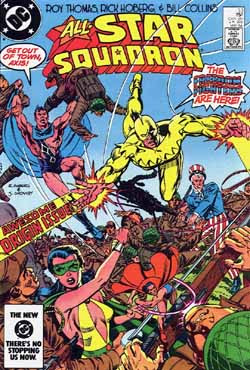
All-Star Squadron #33: Thomas and Hoberg/Collins deliver a split story.  On Earth-X, Uncle Sam and the nascent Freedom Fighters battle a Japanese attack on Santa Barbara only to come face to face with Baron Blitzkrieg who has Hourman in a deathtrap. On Earth-Two, Firebrand and Johnny Quick meet Neptune Perkins, while Starman and Liberty Belle spy on a meeting of Japanese Americans where Tsunami tries to get them to join the Japanese cause. When they refuse, she lashes out, injuring her own father.

Meanwhile, The Spectre is still being held between worlds by the command of the Voice. He tries to get back to Earth-Two but finds his efforts are threatening to draw both Earth-Two and Earth-X together--and maybe destroy them both.


Detective Comics #538: Moench and Colan/Smith bring a mildly amusing follow up to this month's Batman. Collins, Catman's former cellmate, is allowed to break out of prison so he can lead Batman and the police to the loot from his last heist. He steals Catman's costume, and thinks it's giving him nine lives, but it's really Batman secretly helping him out of danger. After a cave in, Batman finds the loot, but Catman winds up in the Batcave, where a weary Batman confronts him and beats the hell out of him.

In a more somber Green Arrow backup by Cavalieri and McManus/Marcos, we get parallel stories of Ollie taking down a gunrunner, Jacaruso, while remembering three years ago how he was to have an interview with a famous musician (heavily implied to be John Lennon) only to have the musician killed in front of him just before. Interestingly, Ollie is referred to as a "gonzo journalist" in this story.


Jonah Hex #84: Hex buys some new guns and heads down to New Orleans on a job to protect the beautiful daughter, Adrian, of a wealthy man from a kidnapping scheme. The girl falls for Hex, naturally, and her fiance is, naturally, not happy about it. They are jumped at Mardi Gras and Hex and Adrian are taken, but ultimately Hex gets them out. The cowardly fiance is out, and now Adrian plans to marry Hex.

Meanwhile, we see Hart and Mei Ling, and Jonah's son who somehow looks about 6 now. Then there's Emmy Lou, still being held captive by the robber, whose advances she keeps spurning.


Nathaniel Dusk #4: McGregor and Colan come to the conclusion, which feels a bit abrupt, but that's not uncommon for the detective genre. Dusk escapes a death by ferry propellor and gets out of the river. He's figured out his friendly corner newsstand owner has been informing on him to the mob. After he confronts that guy, he goes to meet Joyce's mother. She reveals that Joyce was married to an abusive mobster who have never accepted she ran away from him. The blonde goon greets Dusk as he leaves the old woman's apartment, and he's again treated to a deathtrap with an injection of rat poison. After a night in the hospital, he goes to confront the mobster. Blondie accidentally kills his boss in the conflict, then Dusk sets the guy's curly hair on hair in the scuffle. 

Some have complained there isn't a whole lot of mystery here, just "scuffles and chases," which is true, but this is a detective story, so I don't think it's out of bounds. At worst, it's one twist short. I would agree the story is slight for the run time and is filled with action set pieces. It's a level of action more akin to 70s film and TV shows than a reflection of pulp fiction gumshoes, and the ending the first 3 issues on a cliffhanger feels like movie serials. 


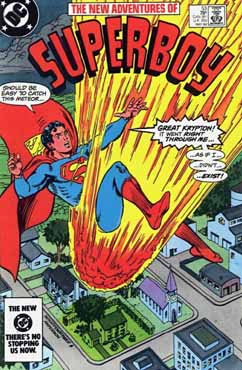
New Adventures of Superboy #53: A lot going on this issue, but the first thing to notice is how different Schaffenberger looks under Giella's inks. After their first assault on Earth fails, aliens from Drulok ally themselves with the Superboy Revenge Squad against Superboy, but that doesn't come to a whole lot this issue. While dealing with these aliens, Clark has to deal with Lana making a play for him in jealousy over his relationship with Lisa. Councilman and profiteer Gary Simmons escalates his attempts to keep Jonathan Kent from running for political office by taking a hit out on him.


Ronin #5: I had almost forgotten this series was still going. Anyway, the Ronin and Casey get closer, and she begins to be able to see things the way he does. For instance, Virgo's new robot soldiers appear as demonic samurai. Meanwhile, McKenna thinks he has pieced most of it together: Billy's telekinetic powers were greater than anyone, but Virgo knew. He created this Ronin identity from TV shows he saw as a child. But what's Virgo after, and what's her role? Five issues in Miller has really established his own style and the influence of European comics and Japanese manga seems more subsumed into his vision.

Monday, February 24, 2025

Setting Presentation Again

 Not for the first time, I've been thinking about the best presentation style for setting material. This time it was prompted by re-reading the Greyhawk Folio and noting it's ergodic nature. While I'm partial to the format I used in Strange Stars, it is very picture heavy and probably works better for science fiction than for fantasy. I am fond of the approach Jack Shear took in Krevborna and here's an attempt at the Holy See of Medegia (which I've covered before. Sorry!) presented in a format that borrows a bit from that and a bit from other places like Fabula Ultima and Strange Stars OSR.

MEDEGIA

The Holy See of Medegia

Theocrat fiefdom ruled by a corrupt cleric allied to the Overking of Aerdy

While nominally still the supreme religious authority in the Aerdi lands, the Holy Censor has seen his clerical authority decline with the weakening of the Great Kingdom, even as his temporal power has increased over holdings granted and seized around the city of Mentrey. The Censor remains an ally to the Malachite Throne, if a cautious one, he cares little for the moral or temporal restoration of Aerdy so long as he can continue to fill his own coffers.

Aesthetics: High-spired temples; imposing and stern marble statues of Lawful gods; clergy dressed in finery, the poor groveling for alms outside the temple doors; swaggering mercenaries in livery of the temples, chained debtor in public stocks

Locales: forbidden, hidden library of the Holy See, reliquary with the remains of saints of heroes, secret site to worship chaos gods in the forest

People:

  • Spidasa, His Equitable Nemesis, Holy Censor of Medegia. Unimaginative as he is venal and grasping.
  • Sister Hildegrund, Imposing, scarfaced former paladin with a vow to aid the poor. Abbess of a hospital in Pontylver.
  • Captain Ribaldo Belswagger, Captain of the City Guard, mustachioed dandy who is always looking for a bribe.
  • Delienn Goodfellow, Wood elf bandit, Robin Hood-type figure to the rural peasantry.


So with this I was looking to convey the basics of the area so that a DM could understand it quickly and know how to convey it features in game. I also wanted adventure seeds to immediately come to mind. I probably would even suggest some possibilities, but I also want to keep it short. The bit of history paraphrasing the Folio might be unnecessary, but I feel like it helps the entirety of the setting cohere, maybe.