Showing posts with label talislanta. Show all posts

Sunday, January 6, 2019

Cymrilians [5e race]

The country of Cymril lies at the center of Seven Kingdoms and its green crystal-spired capital is the greatest city and unofficial capital of the alliance. It's people are descendants of the Phandre, masters of sorceries and rulers of Old Phaedra, until a rebellion instigated by the Orthodoxist faithful. Many Phandre were put to torment, but most of the wizards fled like beetles exposed beneath an upturned stone. In the wilderness they founded Cymril.

The Cymrilians are counted among the Talislantan races of men, so the standard human 5e racial options could be used for them. However, I think something like these variant human subtypes probably fit the Talislantan millieu better. Unless otherwise noted, treated them as human in particulars.

Cymrilian Traits:
Ability Score Increase: Intelligence score and one other ability score increases by 1.
Size: Cymrilians are taller and leaner than human average, with most around 6 feet in height. Medium.
Skills: Gain proficiency in one skill.
Magical Aptitude: Though not all Cymrilians are wizards, all possess at least a small magical facility. Each knows one cantrip of the player's choice from the wizard list. Intelligence is the spellcasting ability for it. 
Languages: Cymrilians can speak, read, and write Low Talislan and High Talislan.
Subrace: Choose one of following subraces.

Koresians
Typically just called Cymrilians, they are the dominant group in society. They have pale green skin and hair, and golden eyes.
Ability Score Increase: One ability score increases by 1 point.
Magical Society: Gain proficiency in Arcana.
Languages: Koresians can speak, read, and write ancient Archaen.

Tanasians
Tanasians are the exiled descendants of the former Phandre ruling caste and make up less than two percent of the Cymrilian population. Some have been raised in exile by families perhaps yearning to regain their former glory. Others may have gone to live in the wilderness, abandoning what they seen as the folly of their ancestors and political intrigues. Tanasians physically resemble Koresians.
Ability Score Increase: One ability score increases by 1 point.
Skills: Traditionally raised exiles gain proficiency in Arcana, while dissenters gain proficiency in Athletics and Survival
Languages: Traditionally-raised Tanasians speak an additional language, likely one related to their place of exile.

Pharesians
Make up about three percent of Cymrilians. They are voluntary exiles and nonconformists, owing to historical prejudice against the lime green of their skin. Many become itinerant peddlers of talismans and arcane parephenalia.
Ability Score Increase: Wisdom score increases by 1 point.
Skills: Gain proficiency in Perception and one other skill.

Wednesday, January 2, 2019

Jaka from Talislanta [5e Race]

Art by P.D. Breeding-Black
Jaka are humanoid species with features resembling both wolves and panthers. They are covered in sleek black fur and have silver-gray manes. They hail from the beast-haunted wilderlands of Yrmania, particularly the area of the Brown Hills.  With a reputation as peerless trackers, Jaka easily find work as scouts, guides, and hunters of both men and beasts.

Jaka Racial Traits
Ability Score Increase. A Jaka's Dexterity increases by 2, and Wisdom increases by 1.
Age. Jaka reach adulthood around age 12 and typically leave to around 80.
Alignment. Most Jaka are neutral.
Size. Jaka are Medium.
Speed. Base walking speed is 30 feet.
Languages. Jaka can speak, read, and write Low Talislan and are fluent in Wilderness Sign of the Talislantan tribes folk.
Darkvision. Jaka have a cat’s keen senses especially in the dark. They can see in dim light within 60 feet of you as if it were bright light, and in darkness as if it were dim light. Jaka can’t discern color in darkness, only shades of gray.
Natural Tracker. Jaka have proficiency with the skills Survival and Perception.
Scent Marking. As a bonus action, a Jaka can mark one creature it can see within 10 feet. Until the end of the Jaka's next long rest, its proficiency bonus is doubled for any ability check to find the marked creature, and the Jaka always know the location of that creature if it is within 60 feet. A Jaka can’t use this trait again until it finishes a short or long rest.
Sixth Sense. Jaka have the uncanny ability to sense danger, or even potential danger within 30 feet. They cannot necessarily discern the type, location, or degree of danger, but they know it is there on a successful check of their Passive Perception (Wisdom). In cases where they are actively looking for threats they have an advantage on their Perception (Wisdom). They are particularly sensitive to magic and add 5 to their Passive Perception checks if magic is involved and +2 to their active checks.
Jaka Weapon Training. Proficiency with the shortsword, shortbow, and spear.


Friday, March 16, 2018

Kickstarters Fulfilled

I've had several Kickstarters I backed drop their products in the last few weeks, and though some of them had longer than expected waits, I've been pretty pleased. Here's a brief rundown:


Talislanta: The Savage Land is a "prequel" to Talislanta as we traditionally have known it, written (at least in part) by Talislanta's creator Steven Michael Sechi. It's more barbaric setting loses so of the Vancian nature of the original and the various cultures are often familiar but different which will take so getting used to, but it has the creativity I expect from a Talislanta book and probably the highest production values yet.


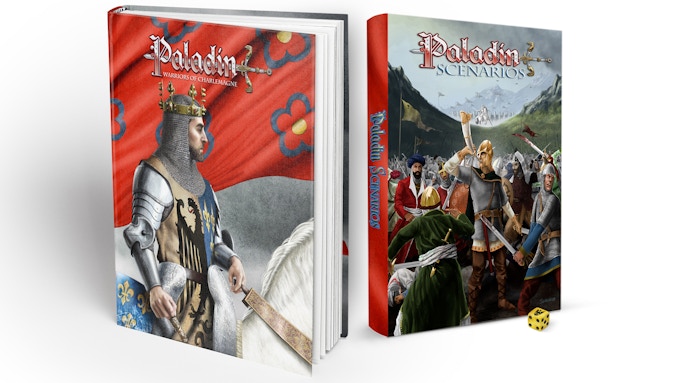
Paladin: Warriors of Charlemagne adapts Pendragon's rules to Charlemagne's court as depicted in the Song of Roland and related Romances. I haven't dug much into this one yet, but Pendragon has a good ruleset, and this is a setting that has always interested me.

Aquelarre is the English translation of a well-regarded Spanish rpg. It bills itself as "A Medieval Demonic Roleplaying Game" which says it all really. Just browsing it, I'm really digging the wealthy of detail on the setting, broken down in easy to digest, pretty playable pieces. There are a host of classes like Muccadim (Jewish militia in ghettos) and Goliardo (licentious, worldly young monks) (the whole chargen system reminds me a bit of WFRP at first blush) and a number of monsters from Basque and Spanish folklore.

Thursday, September 14, 2017

French Talislanta Art

While the English language Talislanta books are (currently) out of print (but official available for free here) the French translation of the game is still going strong, and apparently has some pretty cool art. Check these out:


The Ur

Phantasians

Mondre-Khan

Thursday, February 14, 2013

Talislantan Space: In the Expanse

The Zaran Expanse is a region of decimated star systems and damaged worlds, the epicenter of the devastation of the Great Disaster. The area gets its name from the ancient Zaran Empire, though how much of the territory the empire actually controlled is a matter of debate. Traversing through and residing in the Expanse are a mix of species from all over the galaxy:


A Nagra bounty hunter draws on his quarry. The Nagra's "spirit tracking" ability allows them to trace the psychic ripples of their prey's passing, even across space.


A group of Zandir fencers perform an exhibition bout.


Two Batrean females run a confidence game.


A rare glimpse of a Muse Empath outside the Seven Worlds Alliance.

Sunday, February 3, 2013

Talislantan Space: Kasmirans


Kasmirans are a short, lean, humanoid species with heavily wrinkled skins. Displaced by the Great Disaster, they now inhabit an arid world near the Seven Worlds Alliance's border with the Zaran Expanse. Despite their origin as refugees, the Kasmirans have become a wealthy people, though how they acquired this wealth is not entirely clear. They are infamous throughout the galaxy, however, as misers and shrewd negotiators.

The Kasmirans have maintained (and expand) their fortunes through investment banking.They have a reputation for ethical behavior and conservative investment, but also infamous as sticklers for the letter of contracts and for their hard credit terms.

Kasmiran society is divided into clans. The heads of these clans elect a Chief Executive Officer of Kasmir. When the Kasmiran clan leaders lose confidence in a CEO, he or she is replaced--and memory-wiped to insure the protection of secrets. This process is referred to as “beheading.”

Their desire to protect their wealth (and the wealth of their clients) has led the Kasmirans to become experts in both physical and data security. Prevailing Kasmiran aesthetics in physical security measures tends to favor clockwork mechanical devices with only sparing use of electronics; they extend this mechanical design into the nanoscale.

Kasmir City, the capital of the world of Kasmir, has a walled and check-pointed city center full of windowless high-security towers where the wealthy Kasmirans reside. Offworlders that work for them reside in the more modest areas surrouding it.

Friday, January 25, 2013

Some Images from Talislantan Space

Well, not really, but they work reasonably we for it:


Chana warrior.


Jaka manhunter.


Mondre Khan.


Sarista.

Thursday, January 24, 2013

Talislantan Space: Cymrilians


The planet Cymril lies at the center of the Seven Worlds Alliance. Its capital and only city--the crystalline megalopolis Cymril City (or just “Cymril”)--is the de facto capital of the Alliance and the nexus of trading routes, as well. Beyond the city, Cymril is only sparsely populated wilderness, dotted with small settlements.

Cymrilians are a green-skinned humanoid species known for their powerful psi abilities. Not all Cymrilians possess these abilities, but psi training and experimentation are central to Cymrilian culture, and the most powerful psionics form the planet's ruling elite. They have even developed technological means of enhancing their mental powers. All children of Cymrilian society are tested at a young age for psi abilities and the most promising are sent to various academies.

Cymril was founded by a people called the Phandre from the Phaedran Star Empire of old. The Phandre exiles split into three factions/sub-ethnicites that exist to the modern day. The Koresians, currently ascendant in Cymril, are forward-thinking and more interested in being involved in galactic society. The Tanasians are conservatives descended from the former rulers of the Phandre. Until their ouster, Cymril was more a authoritarian and expansionistic state. Tanasians instituted a eugenics program to foster psi potential among their people and were generally opposed to alliances with other (lesser in their view) species.

The third group, the Pharesians, are radicals and rejectionists of Cymril society. 
Pharesians are distinct from the Koresians and Tanasians, having a darker green skin-tone. They are outcasts, dwelling in the wilderness outside Cymril City or wandering among the inhabited stars as merchants or traders. Their ancestors considered psychologically unsuitable for advanced psi training, Pharesians are barred from the psionic academies by Koresians and Tanasians alike.

Wednesday, April 7, 2010

Free Talislanta!


As many of you perhaps already know--and the rest should--Stephan Michael Sechi has liberated his creation Talislanta--at least from the black iron prison of out-of-print obscurity. Many of the old books (and perhaps, eventually, all) are offered as free pdfs under the Creative Commons License on talislanta.com.

For the uninitiated, Talislanta is an rpg created by the aforementioned Stephan Michael Sechi, and wonderfully realized by the art of P.D. Breeding-Black, first published by Bard Games in 1987. Most of us first heard of Talislanta through the ads in Dragon proclaiming "No Elves!"

And there were no elves--at least not by name. Indeed there weren't any of the usual Tolkienian or Nordic/Celtic influences common to fantasy gaming. Instead, the eclectic and (dare I say) slightly campy setting, is very Vancian (and is, in fact, dedicated to Jack Vance). Sechi outlined the rest of his Talislantan "Appendix N" in an online interview:

"Besides Vance, there was also Marco Polo's The Travels, Lovecraft's The Dreamquest of Unknown Kadath, certain of the works of William S. Burroughs (from which many ideas of Talislanta's illicit substances were derived), and many others. Visually, I was very much influenced by Salome, a three-part story published in Heavy Metal magazine, and written and drawn by Phillipe Druillet - I've looked for it ever since, but with no success. Richard Corben was also an influence, especially his vivid use of colors; also Steve Ditko's Dr Strange, and his depiction of spells and other dimensions. Those are just a few."
Talislanta has always been a setting I've had a a great deal of affection for, even though I haven't actually played in it that often. It's just fun to read, particularly the Chronicles.

Check it out, if you haven't already.